
Valley Shiners Case Study: Mountain View Villas
The Valley Shiners serves golf courses, strata councils, hospitality properties, storefronts, and commercial buildings across Invermere, Windermere, Radium, Fairmont, and Panorama.
Strata Window Cleaning • Commercial Case Study
Cleaning a large residential strata complex is not simply a matter of arriving with a crew and beginning at the first building. It requires site planning, water management, risk documentation, communication, quality control, and the ability to work around residents and vacation guests without creating unnecessary disruption.
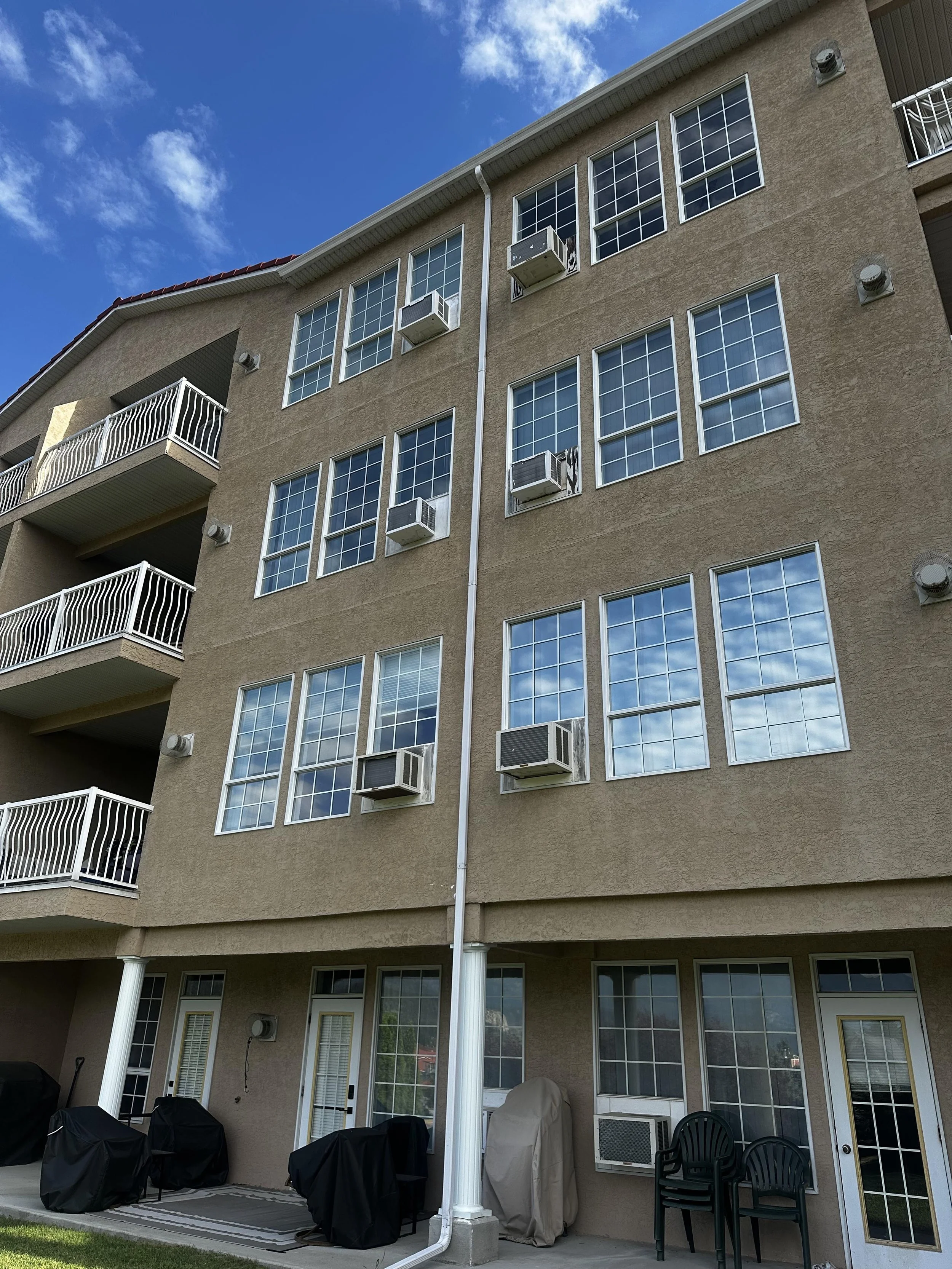
Mountain View Villas is a five-building residential strata community in Fairmont Hot Springs, British Columbia. The property includes more than 700 exterior windows, varied terrain, multiple building elevations, aging window systems, and a mix of full-time residents, second-home owners, and short-term vacation guests.
Valley Shiners completed the full exterior window cleaning project in three working days. Through two pre-project site visits, detailed water-access planning, commercial pure water equipment, long-reach water-fed poles, proactive risk documentation, and daily updates to site contacts, the project was completed ahead of schedule with zero reported callbacks.
Project Snapshot
Property: Mountain View Villas
Location: Fairmont Hot Springs, British Columbia
Property type: Multi-building residential strata community
Scope: Exterior window cleaning across five occupied residential buildings
Scale: 700+ exterior windows, including glass above 50 feet
Timeline: Completed in three working days
Pre-project planning: Two site visits to assess terrain, access, water sources, and potential risks
Systems used: Commercial pure water systems, onboard water storage, water-fed poles, 400-foot hose runs, and inline booster pumps
Result: Finished ahead of schedule with zero reported callbacks
The real question: can a window cleaning company manage a five-building strata project without creating headaches?
For a strata council, property manager, or building representative, the question is not simply whether a contractor can clean glass.
The larger concern is whether that contractor can manage the project professionally from beginning to end.
Decision-makers are asking:
- Will the company assess the property before work begins?
- Can the crew work efficiently across multiple buildings and elevations?
- How will they manage limited water access?
- Can they reach upper-level windows safely?
- Will they recognize and document aging or vulnerable window systems?
- Can they work around residents, vacationers, and short-term guests?
- Will site contacts receive updates without needing to chase the contractor?
- Can the company maintain consistent quality from the first building to the last?
Mountain View Villas provided a strong test of every one of those questions.
The scope: five residential buildings and more than 700 exterior windows
The Mountain View Villas project involved coordinated exterior window cleaning across five separate residential buildings in Fairmont Hot Springs.
The work included:
- Five residential strata buildings
- More than 700 exterior windows
- Upper-level glass above 50 feet
- Multiple building elevations and changing terrain
- A mix of aging and newer window components
- Occupied units throughout the project
- Full-time residents, second-home owners, and Airbnb guests
- Only three functioning exterior water spigots across the full property
This was not a standard residential service route. It was a planned commercial deployment requiring equipment sequencing, crew management, water logistics, risk documentation, resident awareness, daily communication, and active quality control.
Why multi-building strata work is different
A contractor can clean one building well and still fail the overall project.
Large strata projects require consistent execution across multiple days, changing site conditions, different building elevations, varied window types, and occupied residential spaces.
Success depends on planning the entire property rather than treating each building as an isolated appointment.
The challenge: limited water access, aging windows, occupied buildings, and summer conditions
The project presented several overlapping operational challenges.
1. Only three working water spigots across five buildings
Water access is one of the most important—and most frequently overlooked—parts of large-scale pure water window cleaning.
At Mountain View Villas, only three exterior spigots were functioning across all five buildings. The property also included multiple elevations, which meant the closest available water source was not always the most practical one.
Without advance planning, the crew could have lost significant time repeatedly relocating equipment, waiting for adequate flow, or discovering that a planned water source was unavailable.
2. Aging windows required additional care
Several windows and frames showed signs of age, deterioration, or possible vulnerability to water intrusion.
Older windows can require a more cautious approach. A contractor needs to distinguish between dirt that can be safely removed and pre-existing conditions that should be documented before cleaning begins.
Our goal was to improve the glass without worsening existing deficiencies or creating avoidable risk for the strata.
3. A busy summer community remained active throughout the project
Mountain View Villas includes permanent residents, second-home owners, and short-term vacation guests.
During peak summer season, people were arriving, departing, using balconies, walking through common areas, and enjoying the property. The work needed to move efficiently without making the complex feel like a construction site.
4. Wind and high temperatures affected production
Exterior window cleaning quality can be affected by wind, heat, drying speed, and crew fatigue.
High summer temperatures required thoughtful labour management, while changing wind conditions influenced building sequencing and the pace at which upper-level glass could be rinsed and inspected.
Maintaining quality across all five buildings meant managing the crew and the environment—not simply pushing for maximum speed.
Our approach: proactive planning before the first window was cleaned
Valley Shiners approached Mountain View Villas as a managed strata project rather than a collection of individual buildings.
Before mobilizing the crew, we completed two separate site visits to assess:
- Terrain and elevation changes
- Building access
- Working water spigots
- Potential hose routes
- Equipment staging locations
- High-access windows
- Aging or vulnerable window systems
- Resident and vehicle movement
- Potential safety concerns
This preparation allowed the project to begin with a clear plan and reduced the likelihood of surprises once the full crew was on site.
Why two site visits mattered
A single walk-through can provide a general sense of scale, but a second visit creates an opportunity to verify assumptions.
At Mountain View Villas, the additional assessment helped confirm which water sources were actually operational, where long hose runs would be required, how equipment could move between elevations, and which windows deserved extra documentation.
For large strata projects, this kind of preparation protects the schedule, the property, and the final result.
How we solved the water-access challenge
The limited number of functioning spigots could easily have become the primary bottleneck for the entire project.
Instead of relying on a single water source or expecting the property infrastructure to carry the full workload, Valley Shiners used a combination of:
- Pre-scouted building water connections
- Onboard water storage in our commercial service van
- Purified water production systems
- Hose runs approaching 400 feet
- Inline booster pumps to maintain flow and pressure
This system allowed the crew to continue moving efficiently through the property even when the nearest spigot was unavailable, poorly positioned, or located at a lower elevation.
For property managers, this matters because a capable commercial contractor should arrive with enough redundancy to solve predictable site limitations. The project should not stall because a hose bib is broken or a building sits farther from the water source than expected.
Reaching windows above 50 feet without a scissor lift
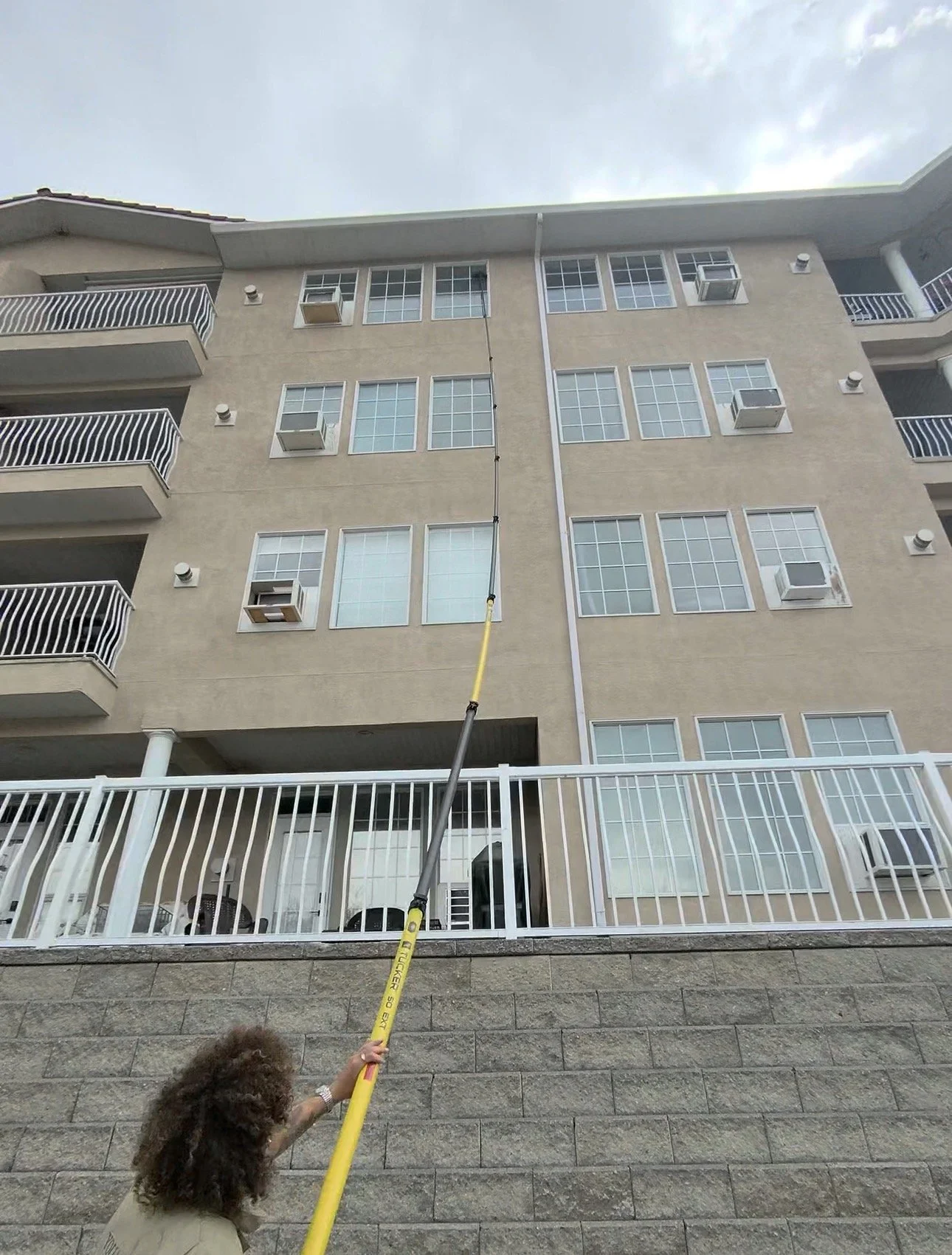
Several windows at Mountain View Villas were located more than 50 feet above ground level.
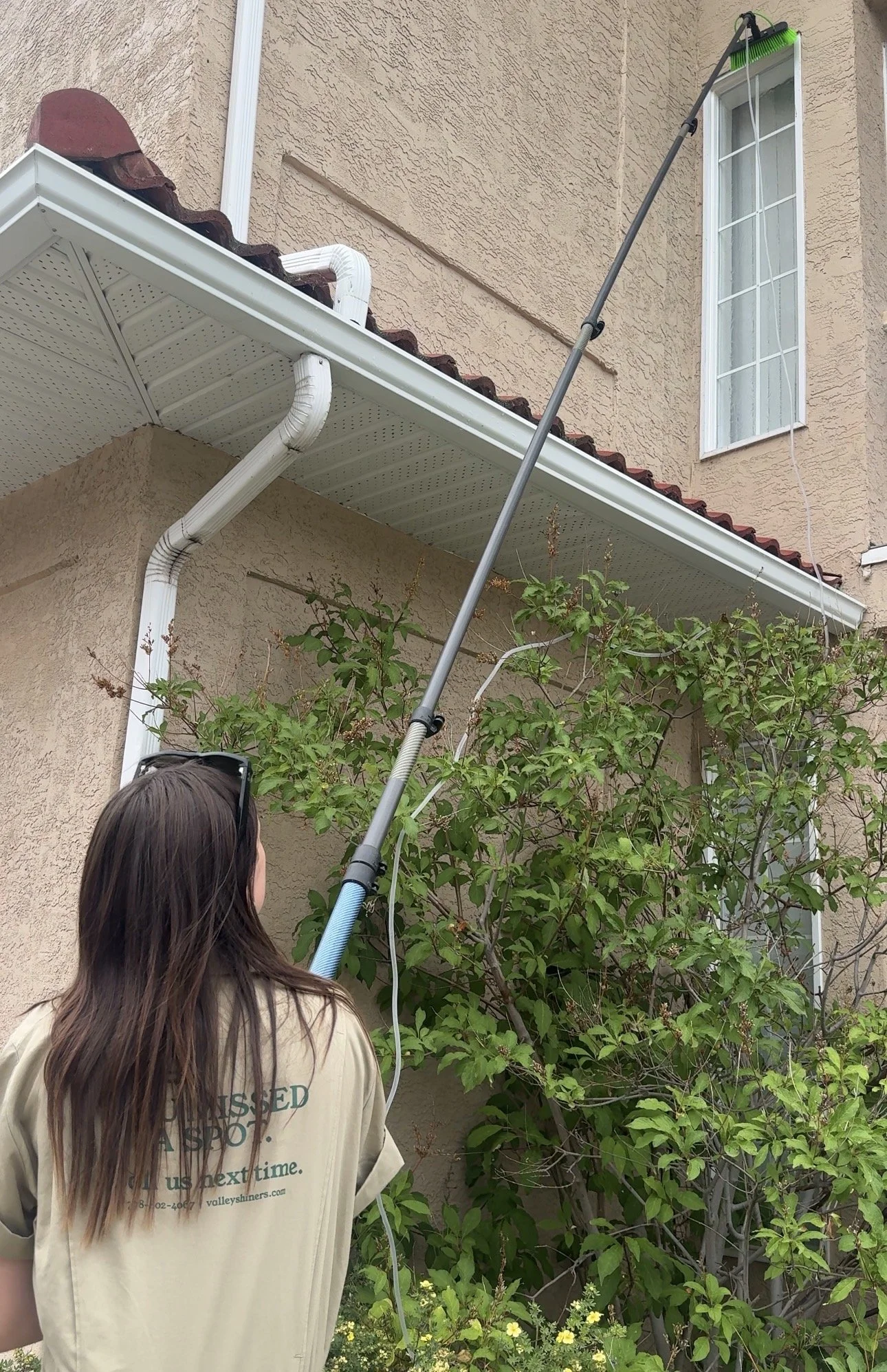
Rather than bringing a scissor lift onto the occupied residential property, Valley Shiners used commercial long-reach water-fed pole systems to clean the high glass safely from the ground.
This approach provided several advantages:
- Reduced disruption: no large lift moving through parking areas or common spaces
- Improved safety: less elevated equipment and fewer high-access transitions
- Faster production: less setup and repositioning between sections
- Lower property impact: no heavy equipment travelling across landscaped or residential areas
- Better fit for an occupied community: fewer barriers, cones, and restricted access zones
Pure water systems use highly filtered water delivered through a specialized brush at the end of a long-reach pole. The glass is scrubbed to loosen dirt, pollen, dust, organic buildup, and exterior grime, then rinsed with purified water that dries clear without the mineral spotting associated with untreated water.

Proactive risk documentation for aging windows
One of the most important parts of the Mountain View Villas project happened before cleaning began.
During our site assessments, we identified windows and frames that appeared older, deteriorated, or potentially susceptible to water intrusion.
Those locations were:
- Photographed where appropriate
- Documented in our customer management system
- Flagged for the crew before work began
- Approached with modified pressure, flow, or agitation where necessary
This process helped separate pre-existing building conditions from the cleaning work and ensured technicians understood where extra caution was required.
The objective was not to avoid older windows. It was to clean them thoughtfully, recognize their limitations, and avoid turning a known vulnerability into a larger problem.
Why documentation matters for strata councils and property managers
Large residential properties often contain a mix of building ages, replacement windows, original windows, previous repairs, and varying levels of maintenance history.
A professional contractor should be prepared to recognize visible concerns, record them, communicate when necessary, and adapt the cleaning process instead of treating every pane exactly the same.
That protects the property, the contractor, and the relationship between them.
Daily communication kept remote site contacts informed
Many of the project's key contacts were not physically present while work was underway.
Rather than waiting for questions, Valley Shiners provided proactive daily updates outlining:
- Which buildings had been completed
- Which areas were currently underway
- What the crew planned to complete next
- Whether the project remained on schedule
- Any relevant site observations
Several contacts specifically mentioned that they appreciated receiving updates while away from the property.
For strata councils and property managers, communication is part of the service. A large project should not require constant follow-up from the client. Site contacts should be able to understand progress, anticipate the next phase, and feel confident that the contractor is actively managing the work.
A successful strata project should reduce management workload
Property managers and strata representatives should not have to chase a contractor for progress reports. Proactive updates create clarity, reduce uncertainty, and help remote decision-makers stay informed without needing to be on site.
Self-managed quality control across all five buildings
Large projects create a consistency challenge.
The first building and the fifth building need to receive the same level of attention, even after multiple days of production, changing temperatures, wind, equipment movement, and crew fatigue.
Valley Shiners used ongoing, self-managed quality control rather than waiting for the client to identify concerns after completion.
This included:
- Reviewing completed elevations before leaving each work area
- Rechecking upper-level windows from multiple viewing angles
- Adjusting technique when heat or wind affected drying conditions
- Maintaining clear crew sequencing between buildings
- Resolving visible issues while equipment was still staged nearby
Quality control is most efficient when it is built into production. Discovering a missed section while the crew is still at the building is very different from returning days later after equipment has been removed.
Managing wind, heat, and crew labour without sacrificing the result
The project took place during high summer temperatures and changing wind conditions.
Those conditions influence more than worker comfort. They can affect rinse quality, drying speed, equipment handling, productivity, and the ability to consistently inspect large areas of glass.
Our crew schedule and work sequence were adjusted throughout the project to protect both people and outcomes.
That included:
- Prioritizing certain elevations during more favourable conditions
- Managing breaks and hydration during high temperatures
- Rotating tasks to reduce fatigue
- Reassessing upper-level pole work when wind increased
- Allowing sufficient time for quality checks instead of forcing production through poor conditions
Commercial project management means recognizing when environmental conditions should influence the plan. The objective is not simply to move faster—it is to finish efficiently while maintaining a consistent result.
How we minimized disruption for residents and vacation guests
Mountain View Villas remained active throughout the project.
Residents and guests continued using entrances, parking areas, balconies, walkways, and common spaces while the crew moved through the property.
Our approach focused on minimizing friction through:
Planned building sequencing
The crew moved through the complex in a deliberate order based on access, water availability, elevation, and site activity.
Ground-based access wherever possible
Long-reach water-fed poles reduced the need for ladders and eliminated the need for a scissor lift, helping keep parking areas and common spaces more open.
Efficient equipment movement
Pre-planned hose routes and staging locations reduced unnecessary movement through resident areas.
Professional on-site presentation
On an occupied residential property, the cleaning crew becomes part of the environment. Technicians need to work safely, communicate respectfully, maintain organized work areas, and remember that residents may be watching the project unfold.
The goal was to complete the work without making the property feel overtaken by the work.
The result: 700+ windows, five buildings, three days, zero callbacks
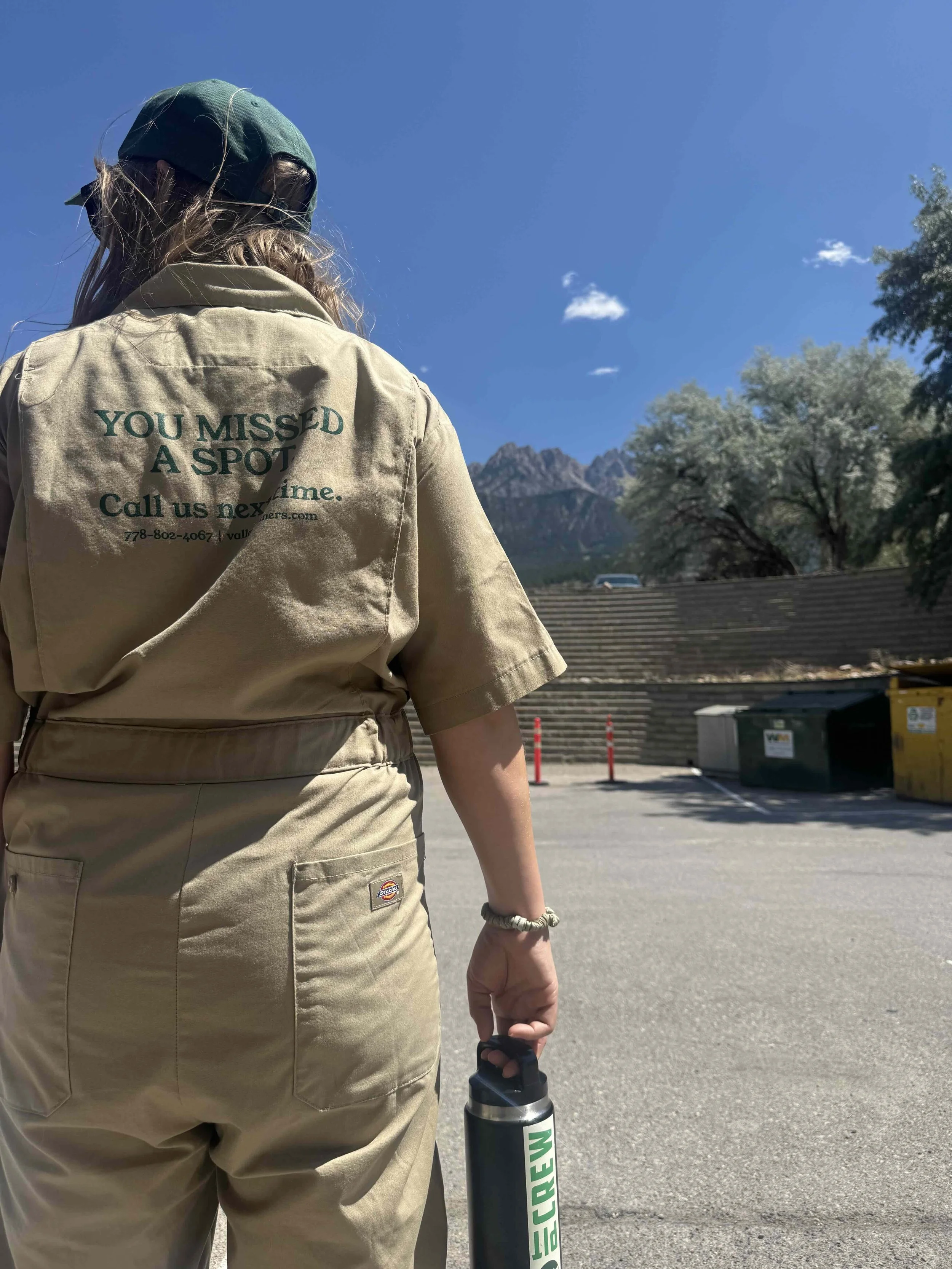
Valley Shiners completed the Mountain View Villas exterior window cleaning project in three working days.
The completed project included:
- More than 700 exterior windows cleaned
- Five residential buildings completed
- Upper-level glass above 50 feet cleaned from the ground
- No scissor lift required
- Only three functioning water spigots successfully managed
- Hose runs approaching 400 feet
- Onboard water and booster systems deployed
- Aging and vulnerable windows documented before cleaning
- Daily updates provided to site contacts
- Minimal disruption to residents and vacation guests
- Finished ahead of schedule
- Zero reported callbacks
Completing the project ahead of schedule meant residents and visitors could return to enjoying the property—and the Columbia Valley summer— without the work extending unnecessarily into additional days.
For a strata council or property manager, that is the outcome that matters: a contractor who arrives prepared, communicates clearly, manages risk, solves site limitations, and completes the project without creating additional work for the client.
What Mountain View Villas demonstrates about large-scale strata window cleaning
The primary challenge at Mountain View Villas was not the act of cleaning windows.
It was coordinating limited water access, aging building components, high elevations, occupied residences, remote stakeholders, summer heat, wind, and consistent quality across five separate buildings.
Equipment helped solve parts of the project, but equipment alone was not enough.
The result depended on:
- Site assessment
- Advance documentation
- Equipment redundancy
- Commercial crew planning
- Clear communication
- Environmental awareness
- Ongoing quality control
These are the operational systems that allow large commercial and strata projects to finish smoothly.
Why pure water window cleaning works well for strata properties
Pure water window cleaning is particularly effective for multi-storey residential properties because it combines efficient production with safer access.
The system filters water to remove dissolved minerals. That purified water is delivered through a specialized brush at the end of a telescopic pole. The glass and frames are agitated to loosen exterior buildup and then rinsed with purified water, which dries clear without typical mineral spotting.
For strata councils and property managers, key advantages include:
- Safer access: many upper-level windows can be cleaned from the ground
- Reduced disruption: fewer ladders and less elevated equipment moving through the property
- Faster production: larger elevations can be cleaned efficiently
- Lower equipment impact: many projects can be completed without lifts or scaffolding
- Consistent exterior results: purified water supports a spot-free finish across large areas of glass
- Strong fit for recurring maintenance: future cleaning cycles become easier to plan once the property has been reset
Pure water is not the correct method for every pane or every condition. Some windows require additional detailing, modified flow, different agitation, or more cautious treatment.
The value of an experienced contractor is knowing when to use the system—and when to adapt it.
What strata councils and property managers should ask before hiring a window cleaning contractor
Mountain View Villas highlights several questions decision-makers should ask before awarding a large residential window cleaning project.
Have they completed comparable multi-building projects?
Residential window cleaning experience does not automatically translate into commercial or strata project capability. Multi-building properties require scheduling, water planning, communication systems, insurance, equipment, and crew coordination.
Will they inspect the property before quoting or mobilizing?
A thorough site assessment helps uncover water limitations, difficult access, aging windows, terrain challenges, and equipment requirements before the project begins.
How will they reach high windows?
Contractors should be able to explain whether they will use water-fed poles, ladders, lifts, scaffolding, rope access, or a combination of methods. The safest and least disruptive approach should be selected for each property.
How will they handle aging windows or existing deficiencies?
Older residential communities may contain vulnerable seals, frames, flashing, or previous damage. Contractors should be prepared to document visible concerns and modify their methods where appropriate.
Will they provide project updates?
Property managers and strata representatives should not need to chase the contractor for information. Large projects benefit from clear communication before, during, and after service.
What is their quality-control process?
A professional contractor should be able to explain how completed work is checked before the crew leaves each building.
Can they adapt to weather and occupied-site conditions?
Wind, heat, resident traffic, parking, balconies, pets, and vacation guests all affect how a strata project should be sequenced.
Why this matters for Columbia Valley strata communities
The Columbia Valley includes a large number of condominiums, townhome developments, vacation communities, resort properties, golf-course residences, and second-home complexes.
Properties in Fairmont Hot Springs, Invermere, Windermere, Radium Hot Springs, Panorama, and surrounding communities face a distinct combination of:
- Seasonal dust and pollen
- Snowmelt and runoff
- Freeze-thaw cycles
- Spider activity and organic buildup
- High summer occupancy
- Remote owners and council members
- Older windows and varied building infrastructure
- Limited local contractor capacity
- Strong expectations from residents and vacation guests
A local strata window cleaning contractor should understand those realities and build the project plan around them.
Valley Shiners has completed large-scale exterior cleaning projects for residential strata communities, resorts, lodges, golf courses, and commercial properties throughout the Columbia Valley.
Related project examples include:
- Panorama Mountain Resort commercial cleaning case study
- Windermere Pointe strata window cleaning case study
- Headwaters Lodge
- Eagle Ranch Golf Course
- Greywolf Golf Course
- Copper Point Golf Club
Update the two case-study URLs above if your live Squarespace slugs are different.
Maintenance planning: moving from reactive cleaning to a predictable strata program
Many strata properties wait until windows are visibly dirty before organizing service.
By that point, the property may be dealing with accumulated dust, pollen, spider activity, organic debris, mineral runoff, and multiple seasons of exterior buildup.
The first large-scale clean often functions as a reset. Once the property has been brought back to a consistent standard, future maintenance becomes easier to budget, communicate, and complete.
A recurring strata maintenance plan may include:
- Annual spring or early-summer exterior window cleaning
- Scheduled multi-building service before peak occupancy
- High-visibility touch-ups for entrances or common areas
- Exterior gutter cleaning where appropriate
- Soft washing for siding, entrances, walkways, and shared outdoor areas
- Documented site updates for remote councils and property managers
Recurring service also allows the contractor to retain site knowledge: water access, difficult elevations, vulnerable windows, preferred staging areas, and the most efficient building sequence.
That creates a more predictable project for both the property and the crew.
Commercial and strata window cleaning in the Columbia Valley
Condominium communities • Townhome developments • Resorts • Hotels • Golf courses • Lodges • Property managers • Strata councils
Exterior window cleaning, commercial pure water systems, long-reach access, site assessments, project communication, and recurring maintenance programs.
Explore commercial & strata services • Request a site assessment
FAQ: Strata and commercial window cleaning in Fairmont Hot Springs and the Columbia Valley
Can Valley Shiners handle large multi-building strata window cleaning projects?
Yes. Valley Shiners is equipped for large residential strata and commercial exterior window cleaning projects. At Mountain View Villas in Fairmont Hot Springs, our team cleaned more than 700 exterior windows across five residential buildings in three working days, finishing ahead of schedule with zero reported callbacks.
Do you complete a site assessment before large strata projects?
Yes. Large projects benefit from pre-service site assessments to confirm building access, terrain, water sources, hose routes, high-level glass, equipment staging, resident considerations, and visible risks such as aging or vulnerable windows. Valley Shiners completed two site visits before beginning the Mountain View Villas project.
Can you clean windows more than 50 feet above the ground?
Depending on access and site conditions, yes. At Mountain View Villas, Valley Shiners used commercial long-reach water-fed pole systems to clean exterior windows above 50 feet while remaining safely on the ground.
Do you always need a scissor lift for high strata windows?
No. Many upper-level windows can be cleaned using commercial pure water systems and long-reach water-fed poles. At Mountain View Villas, the high glass was completed without a scissor lift, reducing disruption and equipment impact on the occupied property.
How do you manage limited water access on large properties?
Valley Shiners can combine available building water with onboard water storage, purified water systems, long hose runs, and inline booster pumps where appropriate. At Mountain View Villas, only three working exterior spigots served five buildings, so hose runs approaching 400 feet and onboard systems were used to keep production moving.
How do you handle older windows or possible water-intrusion risks?
Visible concerns can be documented during the site assessment and recorded in our customer management system. The crew can then modify water flow, brush pressure, agitation, or cleaning technique in those areas. This helps avoid worsening pre-existing damage while still delivering the best practical result.
Can strata window cleaning be completed while residents and vacation guests are on site?
Yes. With proper planning, sequencing, communication, and ground-based equipment, large exterior window cleaning projects can be completed while minimizing disruption to residents, second-home owners, and short-term guests.
Will property managers receive updates during the project?
Yes. Valley Shiners provides proactive project communication for large commercial and strata work. Updates can include completed buildings, current work areas, upcoming sequencing, schedule status, and relevant site observations.
What is pure water window cleaning?
Pure water window cleaning uses highly filtered water delivered through a specialized brush on a telescopic pole. The glass is scrubbed and rinsed from the ground, and because dissolved minerals have been removed from the water, it can dry clear without typical mineral spotting.
How often should a Columbia Valley strata schedule exterior window cleaning?
Many strata communities benefit from annual exterior window cleaning in spring or early summer before peak occupancy. The ideal frequency depends on dust, pollen, tree cover, building exposure, resident expectations, and the condition of the glass. High-visibility areas may benefit from additional seasonal touch-ups.
Are you insured and WorkSafeBC compliant?
Yes. Valley Shiners is fully insured and WorkSafeBC compliant. Our crews are trained for professional on-site work, including ladder safety, ground-based access methods, commercial property protocols, and elevated access planning where required.
What areas do you service?
Valley Shiners provides strata, resort, hospitality, and commercial exterior window cleaning throughout Fairmont Hot Springs, Invermere, Windermere, Radium Hot Springs, Panorama, and surrounding Columbia Valley communities.
