
Valley Shiners Case Study: Wildfire Retardant Removal — A High-Access Exterior Restoration in British Columbia
The Valley Shiners serves golf courses, strata councils, hospitality properties, storefronts, and commercial buildings across Invermere, Windermere, Radium, Fairmont, and Panorama.
Wildfire Retardant Removal • Exterior Restoration Case Study
When aerial wildfire retardant lands on a home, the visible red residue is only the beginning of the restoration challenge. The material may cover several different surfaces at once, remain exposed to sun and weather for weeks, and reach rooflines or elevations that cannot be cleaned safely from the ground.
A successful response requires more than ordinary pressure washing. It requires careful testing, surface-specific chemistry, controlled agitation, specialized access, and realistic expectations about what cleaning can—and cannot—restore.
Valley Shiners was engaged to remove widespread red aerial wildfire-retardant residue from a private residence and detached garage in British Columbia's Columbia Valley. The contamination affected the buildings from the roofline down, including a large metal roof, painted wood siding and trim, decks, stairs, glass, railings, roof vents, skylights, and exterior fixtures.
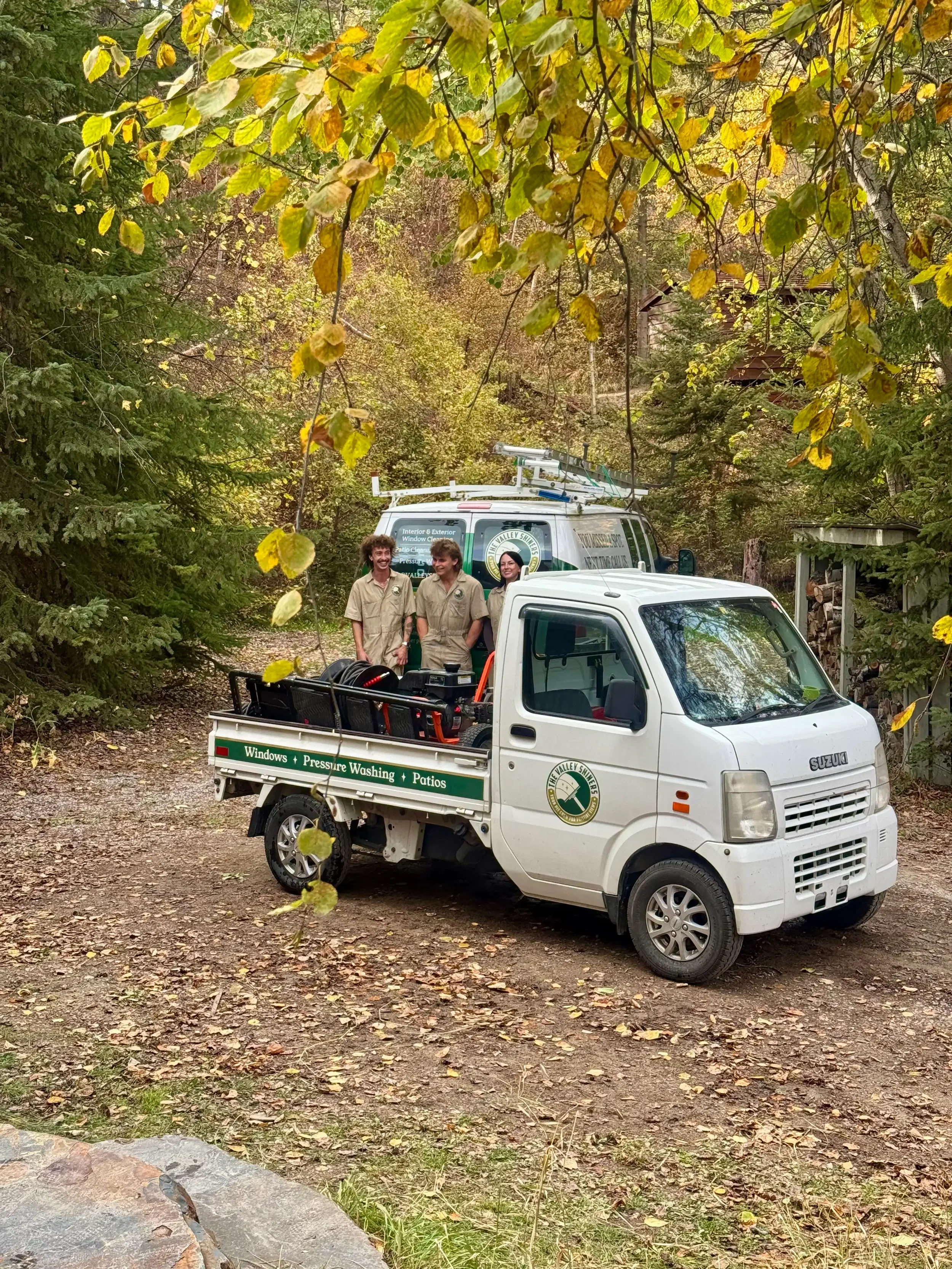
The retardant had been exposed for approximately six weeks before restoration cleaning began. Access was unusually difficult, and parts of the roof sat above a three-storey drop. Over four days, our three-person crew combined a 65-foot boom lift, scaffolding, water-fed equipment, substrate-compatible cleaning solutions, and extensive hand agitation to clean the property without exceeding the approved special-equipment allowance.
Project Snapshot
Property: Private residence and detached garage
Location: Columbia Valley, British Columbia
Contaminant: Dried red aerial wildfire-retardant residue; exact product unconfirmed
Exposure period: Approximately six weeks
Affected surfaces: Metal roofing, asphalt shingles, painted wood siding, trim, decks, stairs, glass, railings, vents, and exterior fixtures
Access conditions: Steep roof sections, four skylights, and areas above a three-storey drop
Access equipment: 65-foot boom lift, scaffolding, ladders, and water-fed poles
Crew and duration: Three-person crew over four days
Cleaning approach: Rehydration, controlled dwell time, soft agitation, and high-volume, low-pressure rinsing
Key constraint: The strongest available restoration chemical was not suitable for wood, and overspray could not be reliably isolated
Result: Major visual improvement across the property, with limitations documented where coatings or finishes had already been affected
The real question: can dried wildfire retardant be removed without creating more damage?
For a restoration contractor or insurance professional, the central question is not simply whether the red colour can be washed away. The real question is whether it can be removed from a mixed-material building without driving residue into joints, stripping coatings, damaging wood fibres, forcing water behind the building envelope, or creating secondary staining on adjacent surfaces.
That distinction shaped the entire project.
The property did not present a single uniform surface. Retardant was present on coated metal roofing, asphalt shingles, painted wood, glass, plastic vents, railings, deck boards, masonry-adjacent components, and outdoor fixtures. Each material carried a different risk profile.
A method aggressive enough to release residue quickly from a durable metal component could be inappropriate for painted siding only a few feet away. The restoration plan therefore had to account for both the contaminant and the substrate beneath it.
What was included in the wildfire-retardant removal scope?
The visible residue extended across most exterior elevations and a large portion of the roof system. This was not a spot-cleaning project. Retardant had reached upper roof surfaces, narrow edges, protected recesses, vertical siding, and small details throughout the site.
The cleaning scope included:
- The primary metal roof and roof edges
- Four skylights and the surrounding roof areas
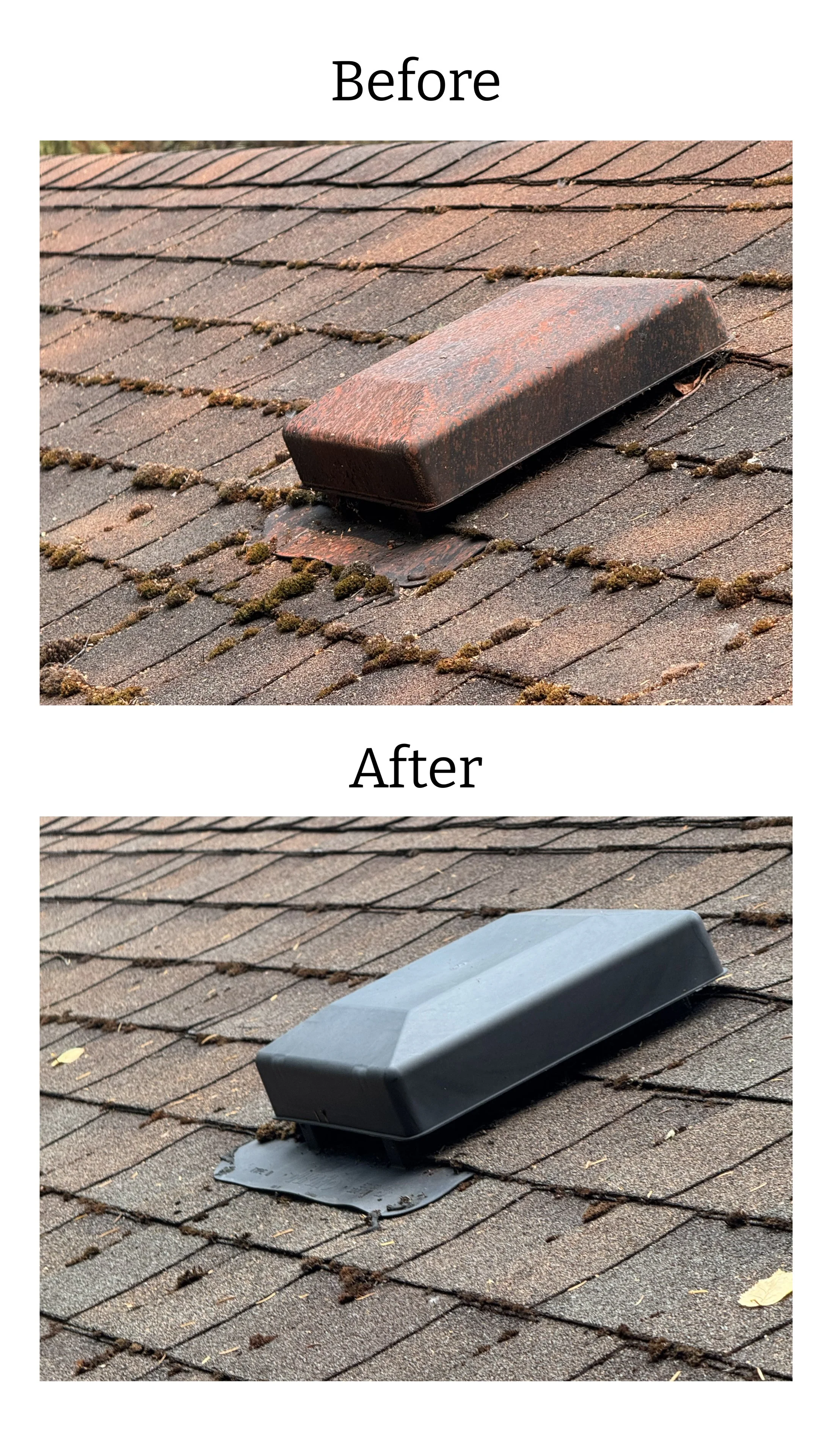
- Sections of asphalt-shingle roofing and roof vents
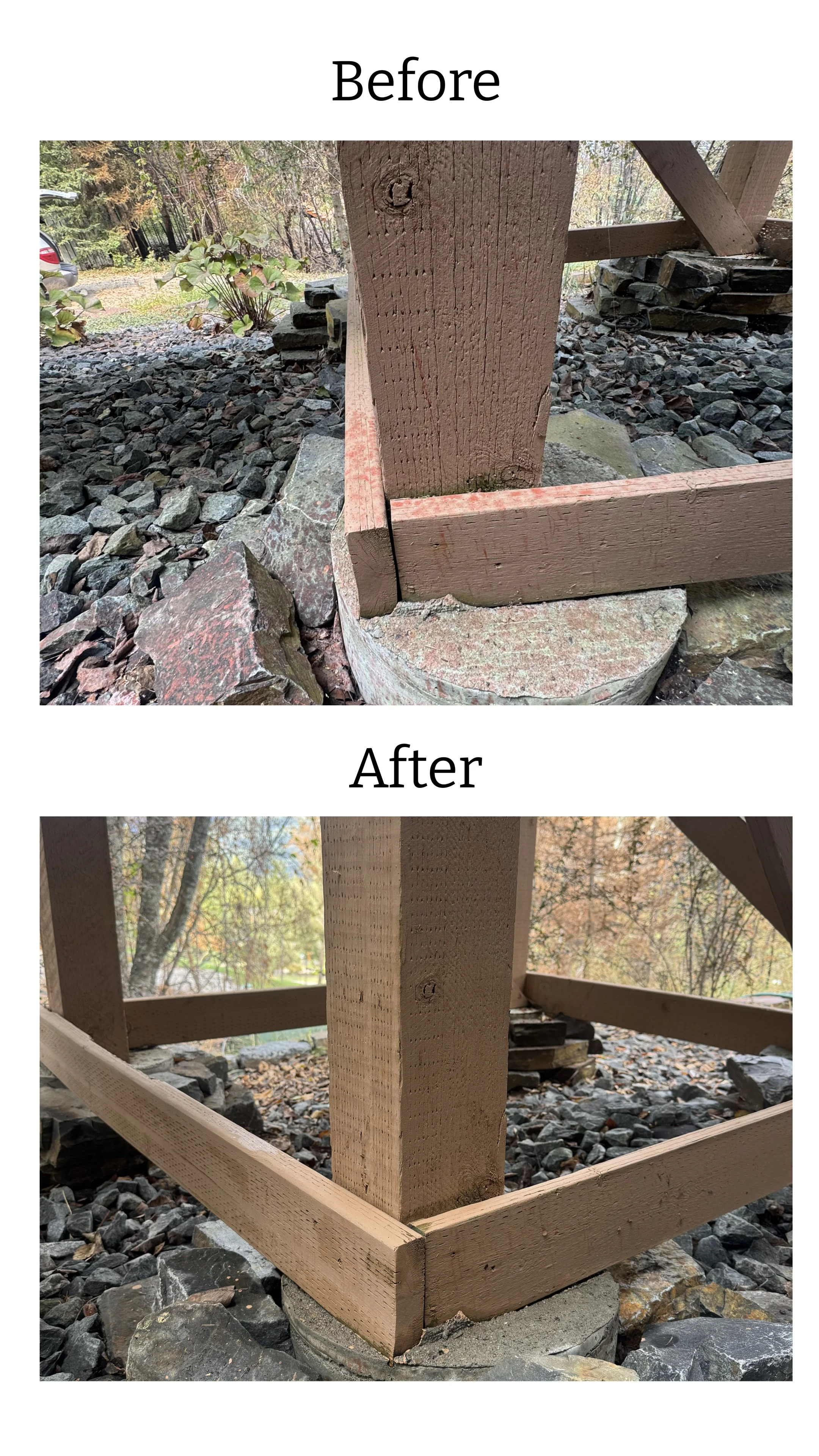
- Painted wood siding, fascia, trim, and structural posts
- Deck surfaces, stairs, and railings
- Exterior windows and glass railings
- Gutters, flashings, and lower painted trim
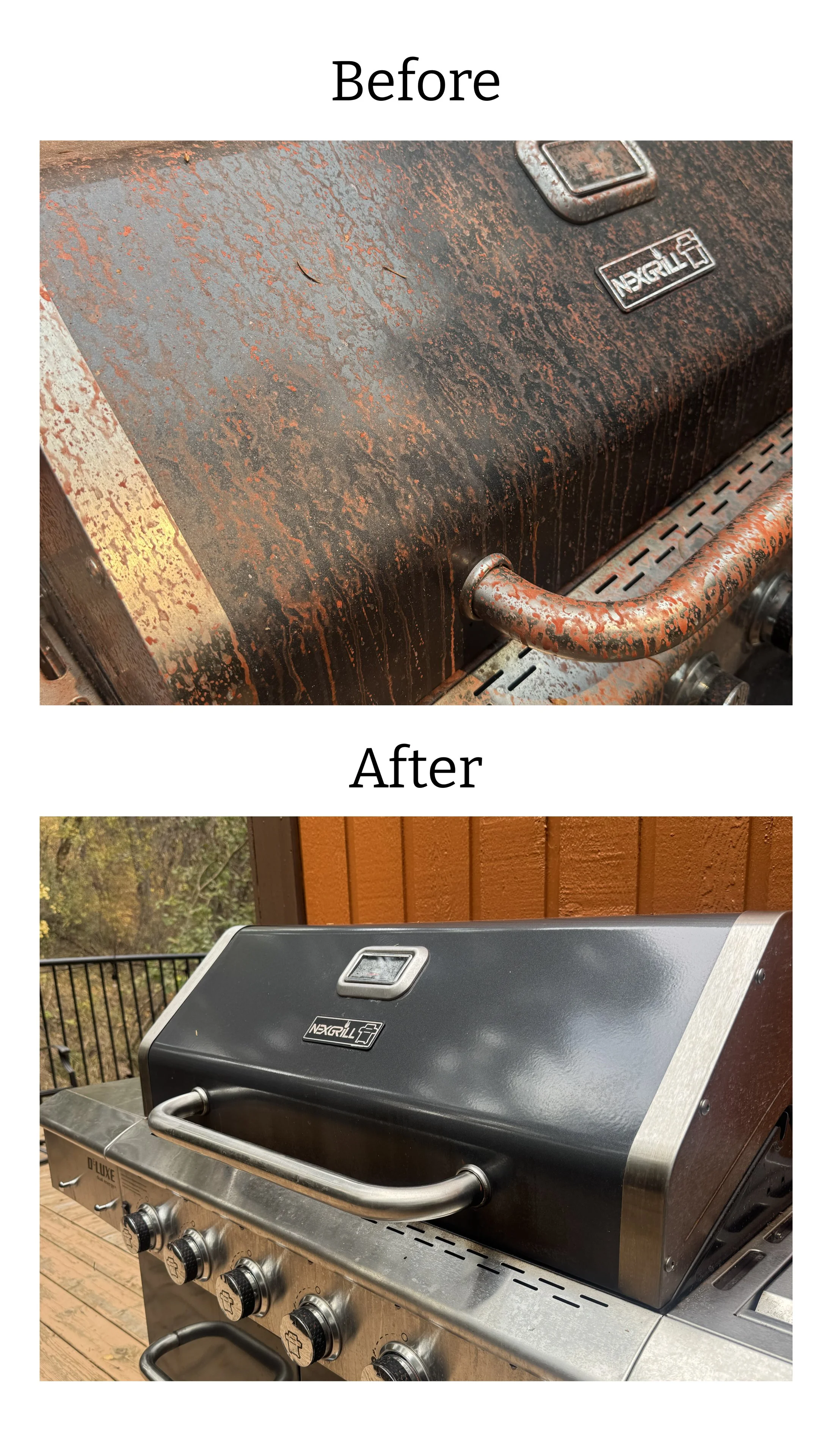
- Outdoor fixtures and equipment, including a barbecue
- The detached garage and associated exterior surfaces
Why ordinary pressure washing was not the answer
High pressure can produce a fast visual change, but speed alone does not make it an appropriate restoration method. On a property like this, aggressive pressure can damage painted wood, open the grain of exposed lumber, disturb aging coatings, force water into assemblies, and spread loosened residue onto surfaces that have already been cleaned.
We deliberately avoided treating the home as a conventional pressure-washing job. The process relied on water volume, rehydration, dwell time, and agitation rather than excessive pressure.
This was especially important on the wood siding, fascia, trim, stairs, posts, and deck components. These materials required enough action to release dried residue while protecting the underlying finish as much as reasonably possible.
How did six weeks of exposure affect the cleaning?
Fresh residue and weathered residue behave differently. By the time this project began, the material had been on the home for approximately six weeks. During that period, it had been exposed to sunlight, temperature changes, dew, rain, and repeated drying.
That extended exposure increased the likelihood that pigments and other components had bonded to, migrated into, or stained porous and weathered finishes. It also meant the residue could not be expected to release uniformly across every surface.
Smooth, intact coatings generally responded more predictably. Porous materials, worn paint, and compromised finishes required more agitation and carried a greater risk of permanent discolouration or visible coating wear after the residue was removed.
Why timely assessment matters
The longer wildfire-retardant residue remains on a building, the more difficult it may become to separate removable contamination from permanent staining or pre-existing finish failure. Once the site is safe, early photographic documentation, material identification, test cleaning, and scope authorization can improve the quality of the restoration decision.
Why didn't we use the strongest available restoration chemical?
We had access to a more aggressive restoration product intended for difficult residue removal. However, that product was not rated for use on wood.
On this property, the metal roof, painted wood siding, fascia, and other sensitive materials were too closely integrated to guarantee that overspray or runoff could be fully contained. Using the strongest chemistry on the roof might have accelerated removal in some areas, but it also would have introduced an unacceptable risk to adjacent wood finishes.
We chose the safer, substrate-compatible approach: milder chemistry, longer dwell time, repeated wetting, soft agitation, and controlled rinsing.
That decision is an important part of professional restoration work. Chemical strength is only one variable. The best process is the one that produces the strongest practical result while respecting the most vulnerable nearby surface.
Our wildfire-retardant removal process
The cleaning plan was built around the condition of the residue, the underlying material, and the access required for each area. No single tool, chemical, or rinse method was appropriate for the entire property.
1. Site assessment and access planning
Before cleaning began, we reviewed the affected elevations, roof geometry, drop hazards, equipment locations, water access, and the relationship between the different materials. This allowed us to divide the property into workable zones and reduce unnecessary movement of hoses, ladders, and equipment.
2. Photographic documentation
We documented visible residue before work began, including representative close-ups and wide views. Documentation establishes the starting condition and helps distinguish contamination from coating damage, fading, or wear that may remain visible afterward.
3. Test cleaning
Small areas were tested before full production cleaning. The tests helped establish how the residue responded on metal, painted wood, glass, and other components, and whether the proposed solution and agitation level were safe for each surface.
4. Surface protection and sequencing
Cleaning was planned from upper surfaces downward wherever practical. Runoff and overspray were monitored so loosened residue was not allowed to dry again on completed areas.
5. Rehydration
The dried residue was thoroughly wetted to begin softening it. Rehydration was not a token pre-rinse; it was a functional part of the process. On heavily affected areas, repeated wetting was required before the residue could be agitated safely.
6. Application of substrate-compatible cleaner
Cleaning solutions were selected according to the material being treated. We did not assume that one chemical concentration was appropriate for every surface on the property.
7. Controlled dwell time
The solution was allowed time to work while the surface remained wet. Sections were sized according to temperature, exposure, and crew capacity so cleaner or residue would not dry prematurely.
8. Soft mechanical agitation
Much of the home required direct brushing. The crew scrubbed the affected surfaces with tools selected for the underlying material, working the solution into textured coatings, seams, edges, and recesses that rinsing alone could not fully release.
9. High-volume, low-pressure rinsing
Released residue was flushed away with controlled water volume rather than destructive pressure. Rinsing was repeated as needed to prevent residue from settling back onto lower surfaces.
10. Detail cleaning and repeat passes
Edges, rails, vents, window frames, roof components, and other detailed areas were inspected closely. Where visible residue remained and the substrate allowed it, the cleaning cycle was repeated.
11. Final glass cleaning and quality control
Exterior glass and glass railings were cleaned after the surrounding restoration work so rinse water and loosened residue did not compromise the final finish. The property was then reviewed for remaining visible deposits and photographed again.
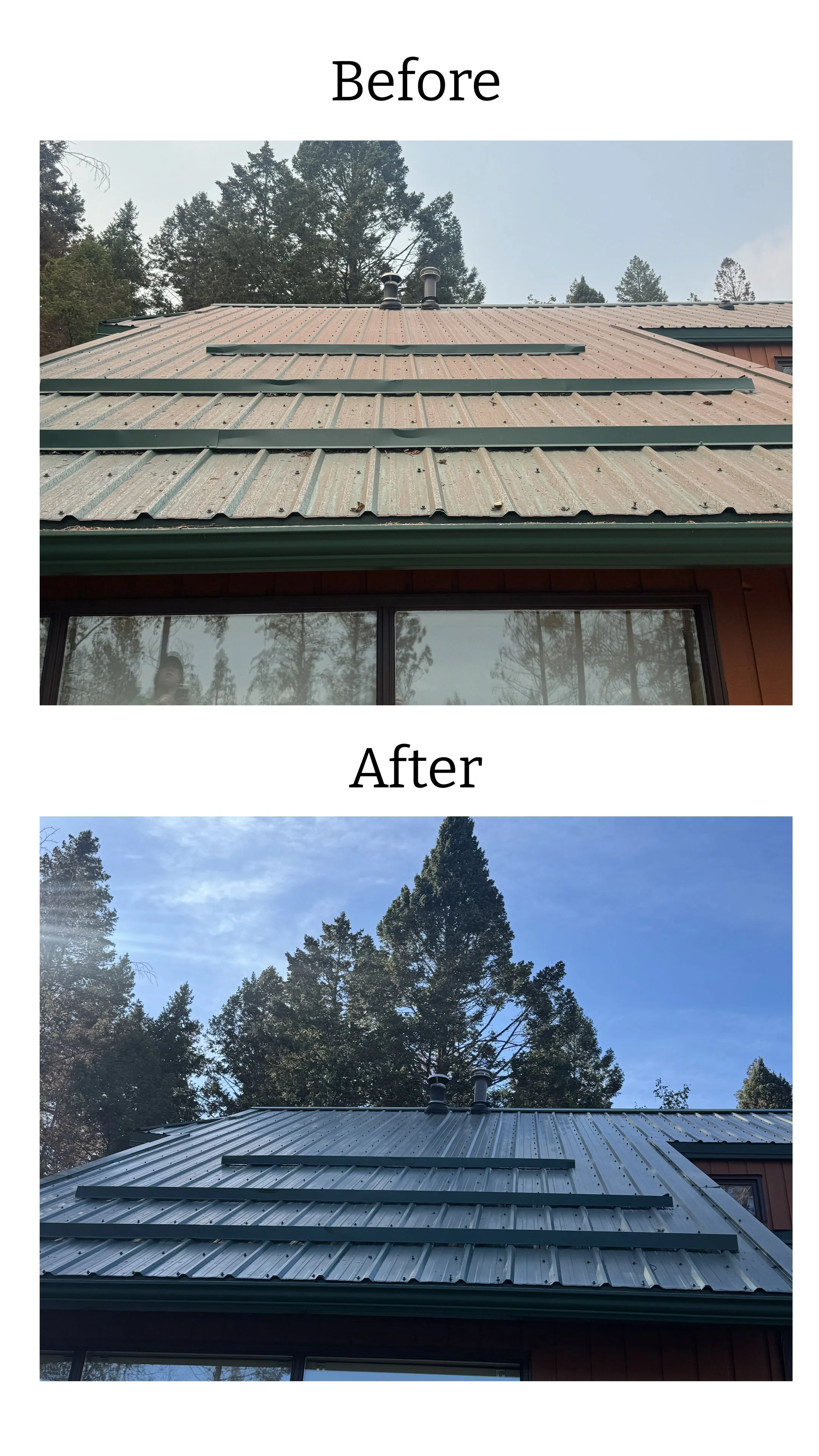
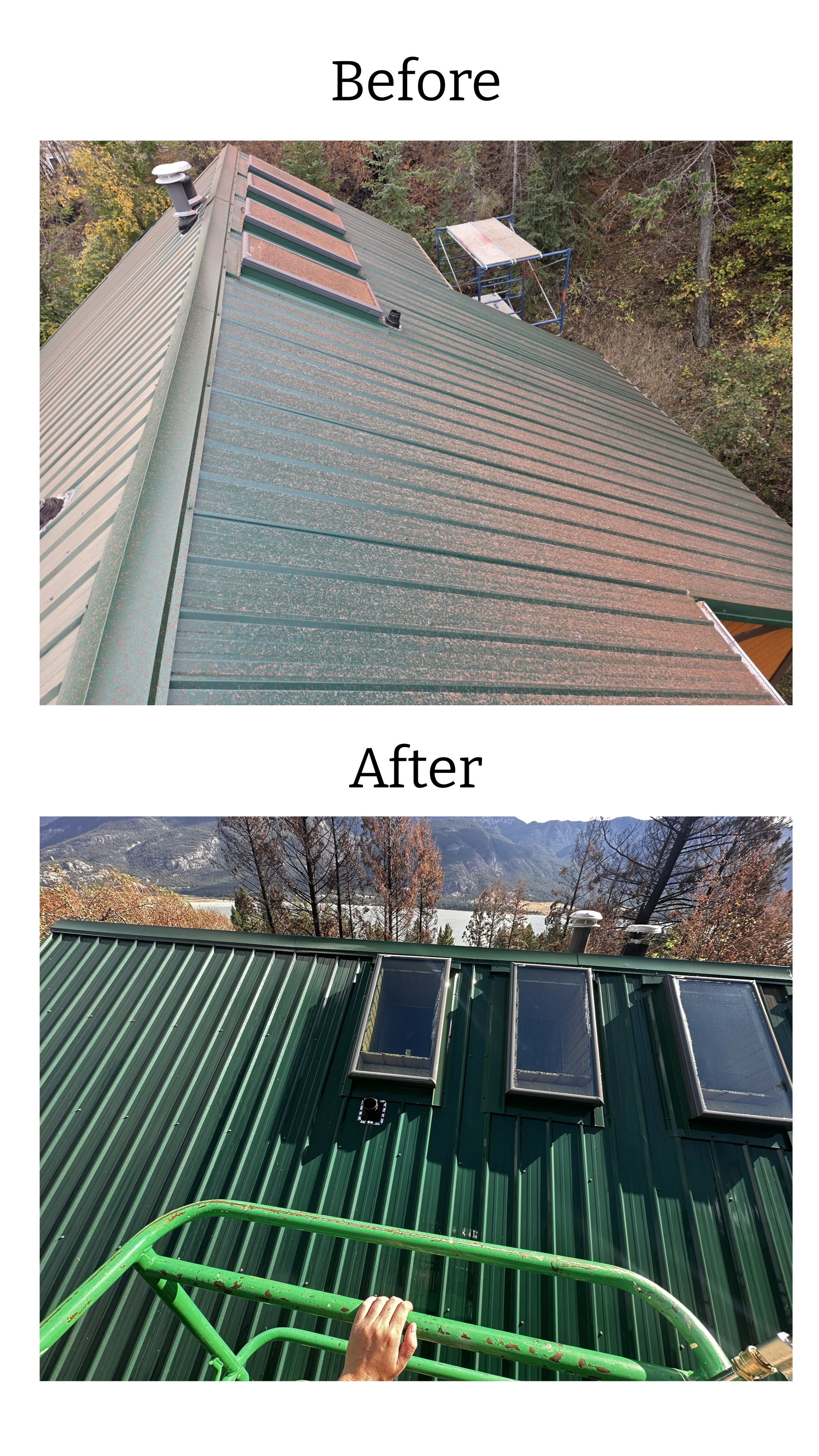
Cleaning the high-access metal roof
The roof was one of the defining challenges of the project. It was large, steep in places, and interrupted by four skylights. Some working areas were positioned above a three-storey drop, making ordinary ladder access impractical and unsafe.
A 65-foot boom lift provided controlled access to several roof edges and elevations. Scaffolding was used where it created a stable working position, while water-fed equipment extended reach in areas where direct access was limited.
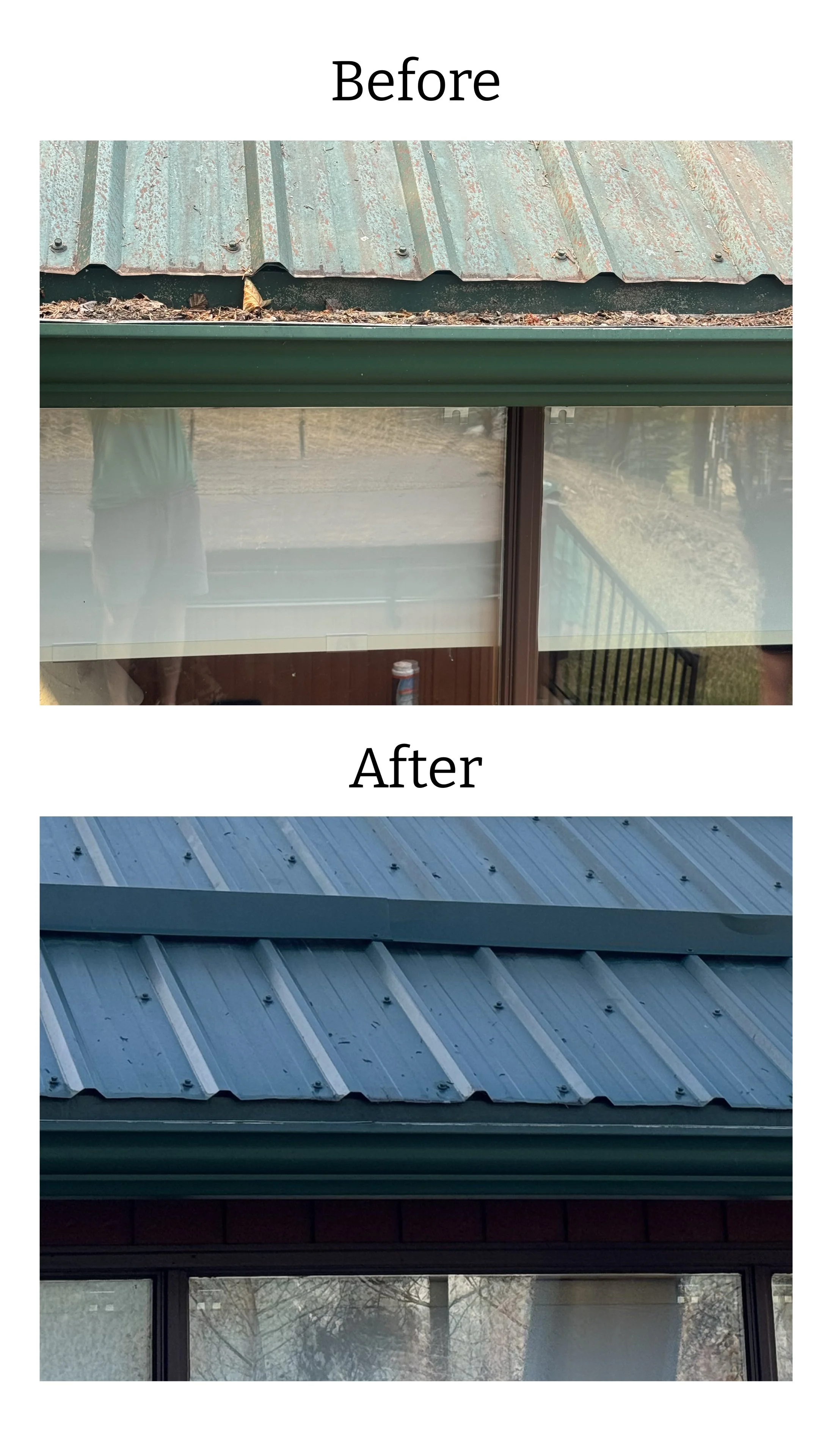
The metal roof also illustrated why the work could not be reduced to a single chemical application. Red residue was distributed across panels, ribs, seams, roof edges, and components. The crew used repeated wetting and physical agitation to release material from the coated surface while managing runoff onto the wood and glass below.
Cleaning painted wood siding, trim, fascia, decks, and stairs
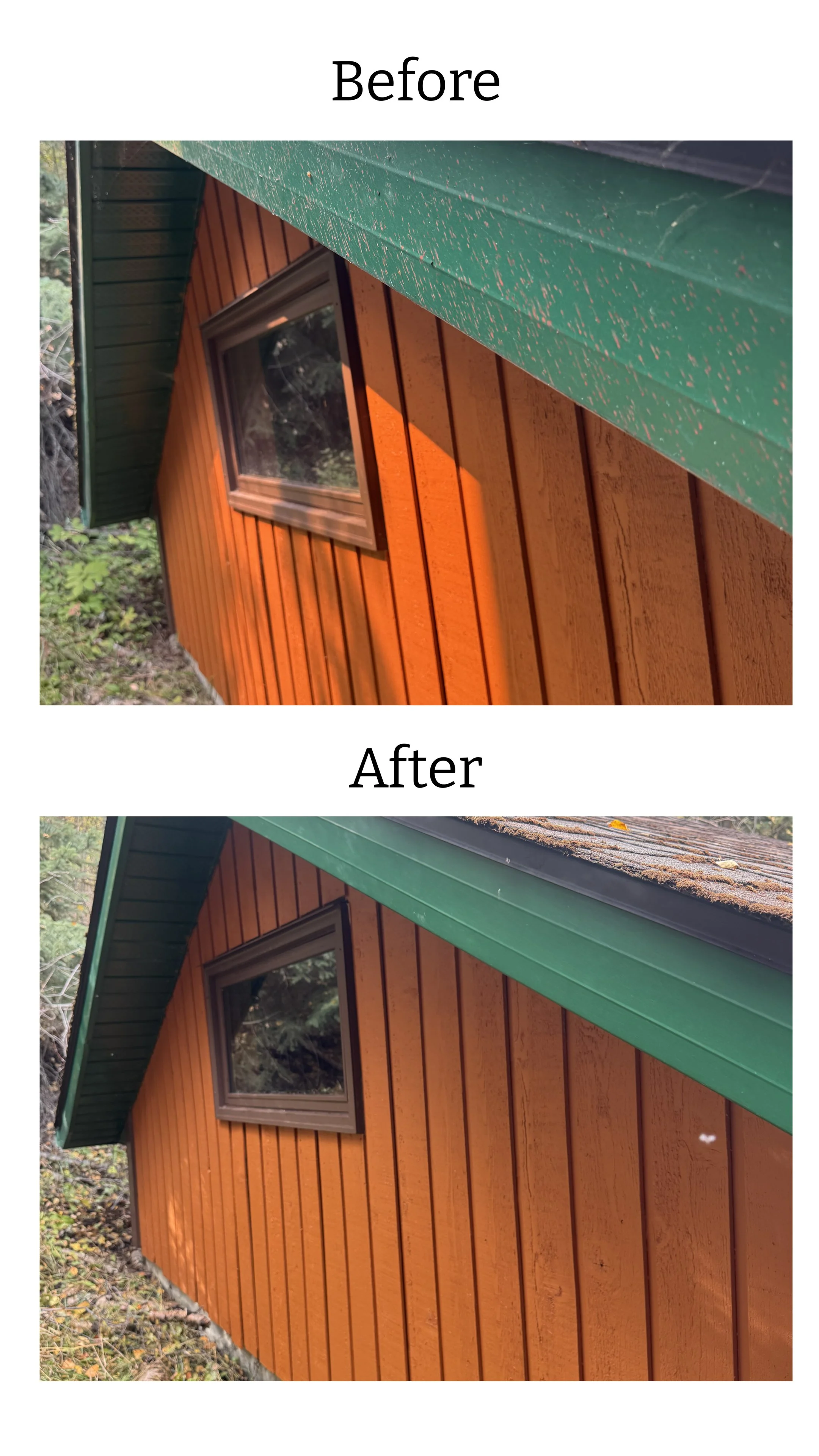
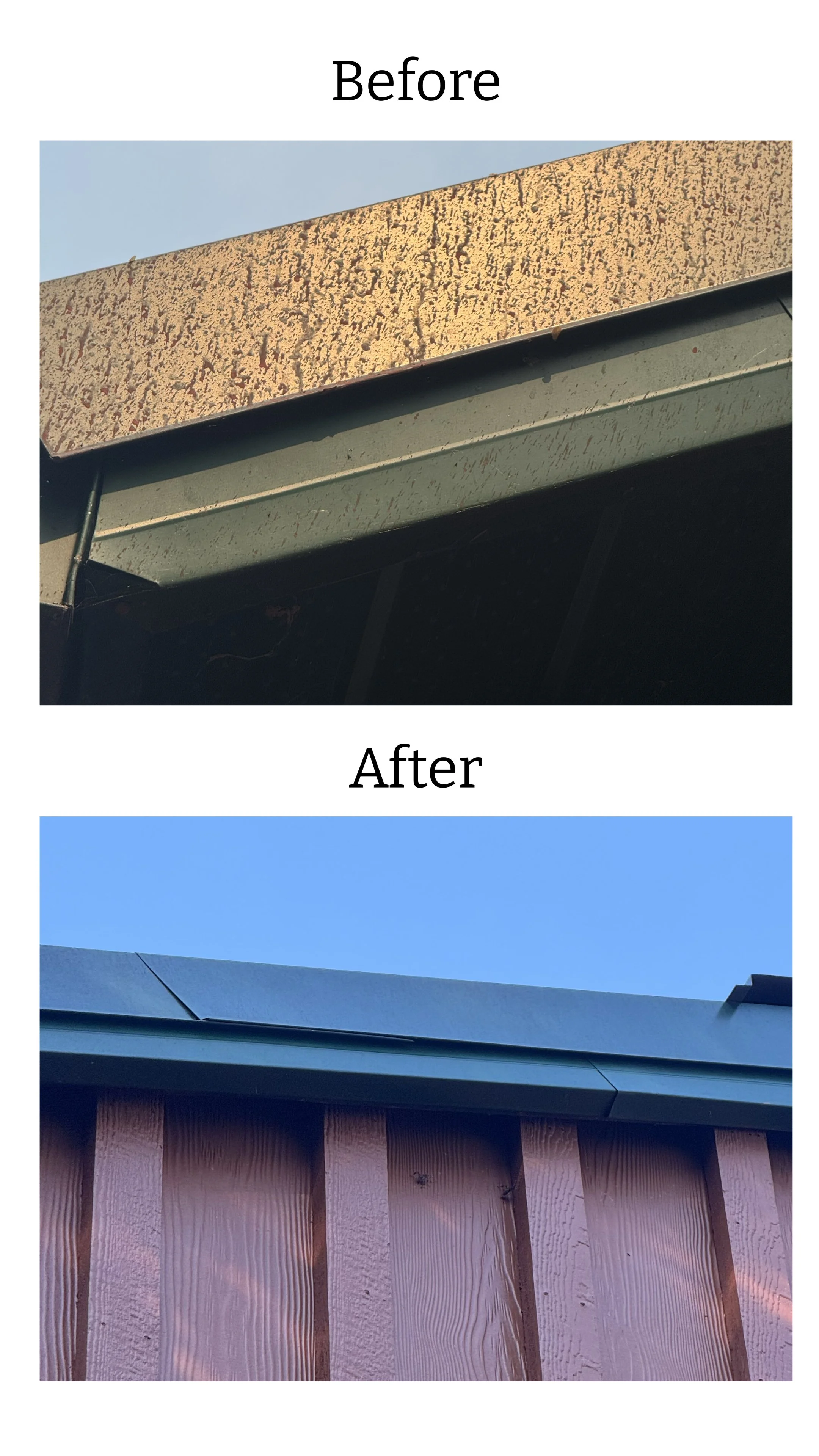
Wood and painted wood were the most sensitive parts of the project. The red residue was highly visible against the home's orange and brown finishes, and it collected in textured grain, joints, edges, and horizontal surfaces.
These areas were cleaned with surface-compatible solution, controlled dwell time, and extensive brushing. The work was labour intensive: each section had to be scrubbed thoroughly enough to release residue without turning the process into paint removal.
The before-and-after results were strong, but they also revealed an important restoration reality. Once contamination is removed, underlying wear can become more apparent. On the stairs and other high-traffic areas, cleaning exposed pre-existing coating loss and weathering that had been obscured by the red residue.
That is not the same as failing to remove the contaminant. It is evidence that cleaning and refinishing are different scopes. Where a coating has deteriorated or absorbed pigment, cleaning may be the correct first step while repainting, staining, or component replacement remains a separate repair decision.
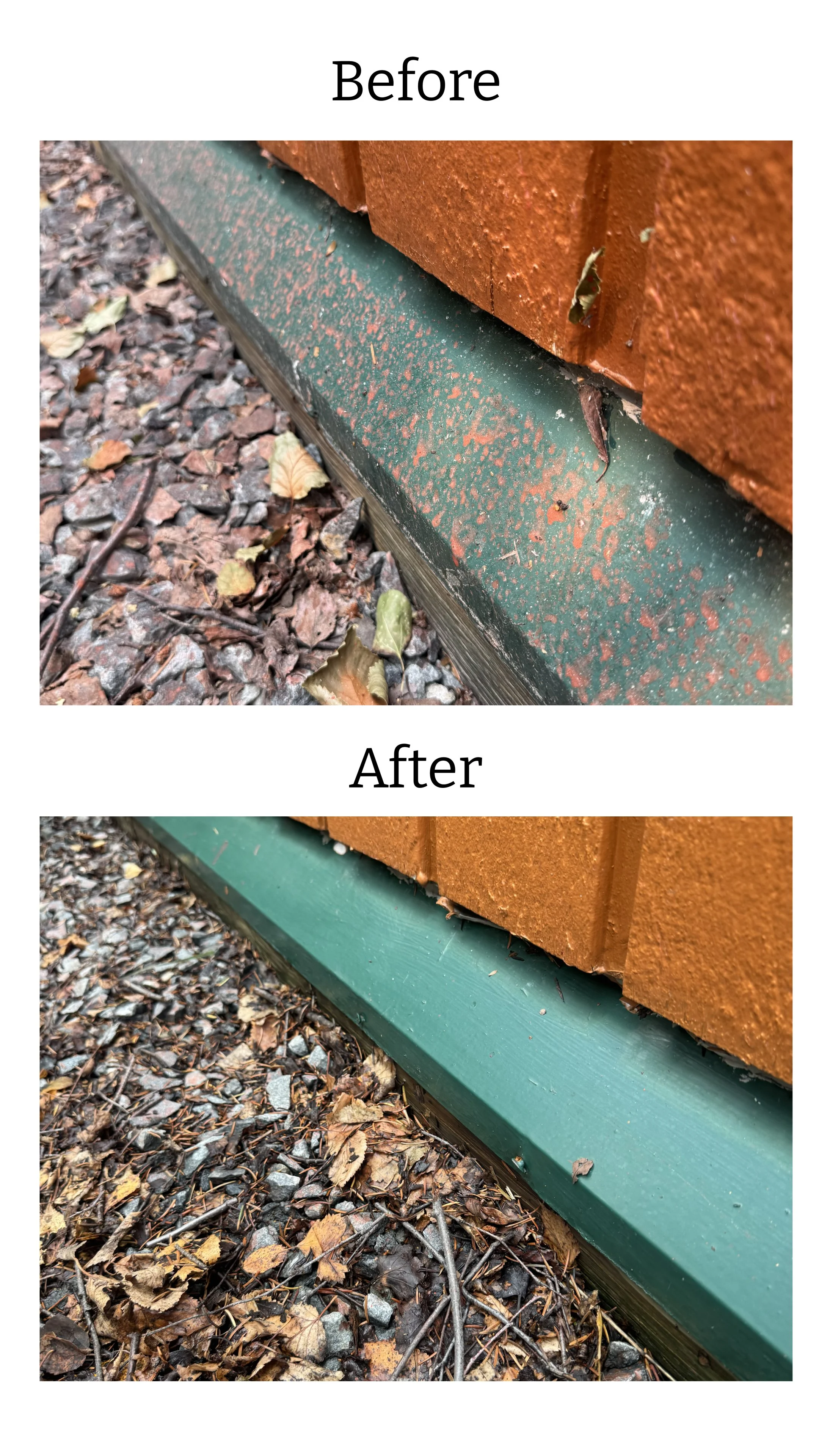
Final glass, railing, and detail cleaning
Glass provided some of the clearest visual evidence of the restoration. Residue on windows and glass railings affected both appearance and visibility. These surfaces were addressed after the heavier roof and siding work so they would not be re-contaminated by runoff.
Frames, edges, and adjacent rails were detailed before the glass received its final cleaning. The result was a major improvement in clarity and a clean transition between restored glass and the surrounding exterior surfaces.
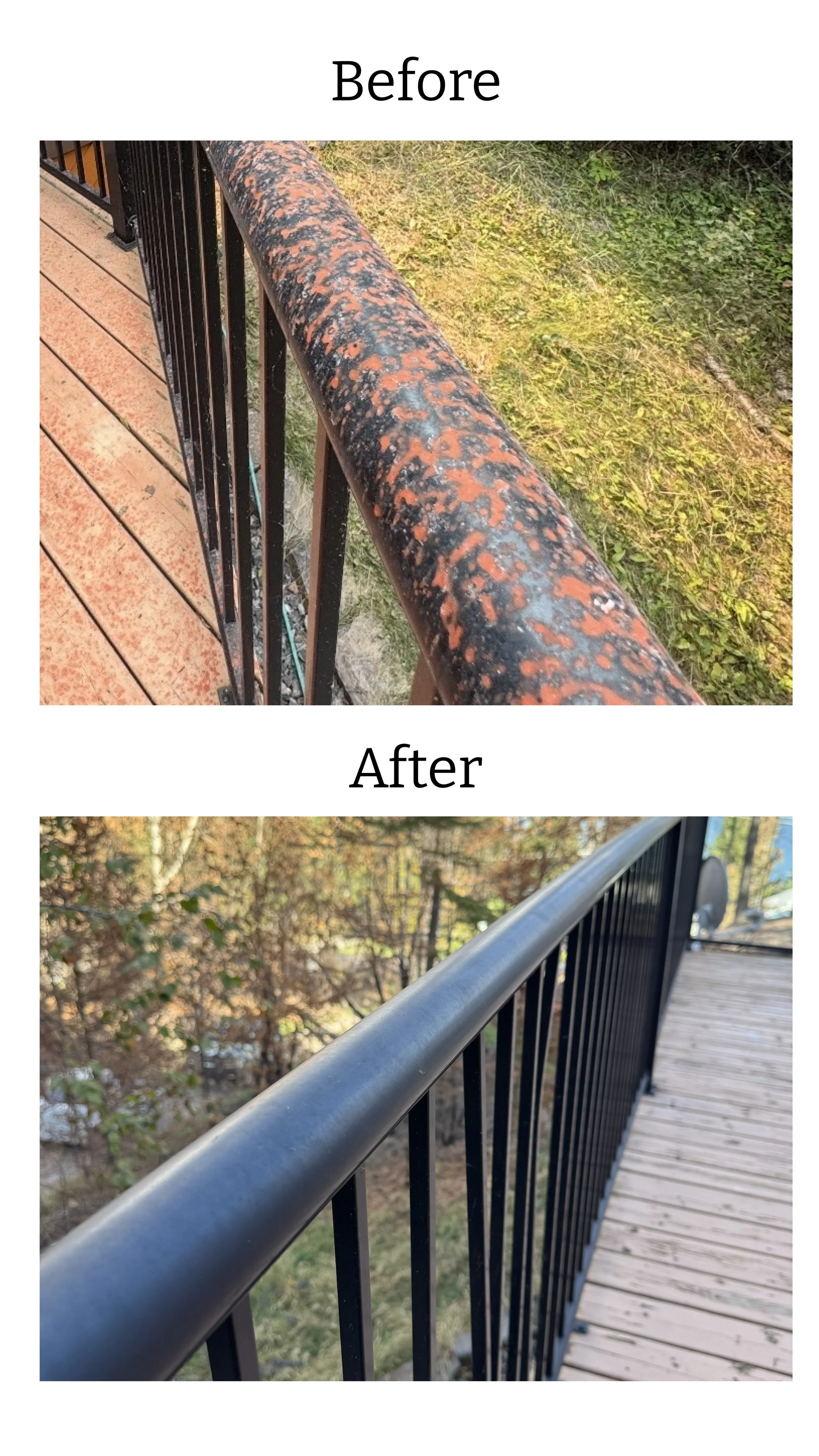
Small features mattered as well. Roof vents, rail caps, lower trim, flashings, and the barbecue all held visible red deposits. Cleaning these components helped return the property to a coherent finished appearance instead of leaving scattered reminders of the incident.
What documentation should a restoration company or insurer receive?
For an insurance-related restoration, the cleaning result is only part of the deliverable. The project file should also explain what was present, what was attempted, which methods were selected, and what limitations remained.
Our project record included:
- Representative pre-cleaning photographs
- Images showing residue on multiple substrates and elevations
- Before-and-after comparisons of key surfaces
- Notes on specialized access and equipment requirements
- Confirmation that the strongest available chemical was withheld because it was not suitable for adjacent wood
- Documentation of finish wear or staining that could not responsibly be addressed through more aggressive cleaning
- A final work summary and pass-through receipts for special equipment
This information allows a restoration contractor, adjuster, or property owner to evaluate the cleaning phase separately from any repainting, refinishing, or replacement that may be required afterward.
The result: four days, three technicians, and a substantial exterior restoration
The project was completed over four days by a three-person crew. It was the crew's first project operating a boom lift, first project working from scaffolding at this scale, and first full cleaning of a metal roof of this size and complexity.
The completed project included:
- The main residence and detached garage cleaned
- A large high-access metal roof restored
- Four skylights and detailed roof components cleaned
- Painted wood siding, fascia, trim, decks, stairs, and structural posts scrubbed
- Exterior windows and glass railings reset
- Boom lift, scaffolding, ladders, and water-fed equipment coordinated on site
- No crew overtime required
- Specialized equipment costs kept below the approved allowance
Most importantly, the visible transformation was substantial. Red residue that had covered roof panels, siding, trim, glass, vents, railings, and fixtures was removed or dramatically reduced. The finished images demonstrate the value of careful restoration cleaning even after several weeks of exposure.
The project also reinforced the importance of honest limits. We did not promise that every material would return to an exact pre-loss appearance, and we did not risk damaging wood or coatings to chase isolated traces. The objective was the best defensible restoration outcome—not an aggressive process that created a new loss.
The restoration standard
The strongest responsible result is not always the most aggressive result. Effective wildfire-retardant removal balances visible improvement with substrate protection, safe access, runoff control, documentation, and a clear understanding of when cleaning has reached its practical limit.
When is cleaning not enough?
Cleaning may not fully restore a surface when:
- Pigment has penetrated porous or weathered material
- Paint, stain, or factory coating was already failing
- The residue has remained through prolonged heat, sun, or repeated wet-dry cycles
- A substrate reacts unfavourably to the chemistry required for complete removal
- Safe access limits the amount of direct agitation possible
- Further cleaning would create more damage than the remaining discolouration
In those cases, the next step may be repainting, refinishing, or replacement. A professional contractor should document that transition clearly rather than treating every remaining mark as a reason to increase pressure or chemical strength.
Questions restoration and insurance companies should ask a local contractor
Before assigning wildfire-retardant removal, ask:
- Have you tested the process on each affected substrate?
- How will you protect painted wood, glass, roofing, and landscaping from incompatible chemistry or runoff?
- Is the proposed chemical approved for every surface it may contact?
- How will you reach steep roofs, upper elevations, and areas above significant drops?
- Will the contractor rely on high pressure, or do they have a controlled agitation and low-pressure rinse process?
- How will they prevent loosened residue from drying again on lower surfaces?
- What pre- and post-cleaning documentation will be provided?
- How will they distinguish remaining contamination from staining or pre-existing coating failure?
- Can they coordinate equipment rentals and provide pass-through receipts where required?
- Will they identify when cleaning has reached a safe practical limit and repair work should begin?
These questions help separate routine exterior washing from restoration cleaning performed for an insurer, restoration manager, or property owner after a wildfire response.
Wildfire-retardant removal across the East and West Kootenays
Valley Shiners is based in British Columbia's Columbia Valley and provides specialized exterior cleaning throughout the East Kootenays. For wildfire-retardant restoration projects, we are also willing to travel throughout the West Kootenays and to other communities where the scope justifies a specialized crew and access plan.
Potential service areas include Invermere, Windermere, Fairmont Hot Springs, Radium Hot Springs, Cranbrook, Kimberley, Fernie, Golden, Creston, Nelson, Castlegar, Trail, Rossland, and surrounding communities.
Travel, access equipment, and scheduling are evaluated project by project. Large residential losses, strata properties, resorts, commercial sites, and multi-building restoration scopes are particularly well suited to a planned mobile response.
Need a wildfire-retardant removal assessment?
Restoration companies • Insurance professionals • Property managers • Homeowners • Strata communities • Resorts • Commercial properties
Send us photographs of the affected building, the property location, the approximate date of exposure, and any available information about the retardant.
We can help assess the exterior surfaces, access requirements, likely cleaning limitations, and whether test cleaning or an in-person site visit is required.
FAQ: Wildfire-retardant removal in British Columbia
Can aerial wildfire retardant be removed from a house?
Often, yes. The result depends on the retardant, exposure time, weather, substrate, and condition of the underlying finish. Smooth, intact coatings generally respond more predictably than porous materials or deteriorated paint.
How quickly should wildfire retardant be cleaned?
As soon as the site is safe and the appropriate parties authorize the work. Repeated drying, sunlight, and prolonged contact may make residue more difficult to remove and can increase the likelihood of staining.
Can wildfire retardant permanently stain siding or roofing?
It can. Pigments may remain in porous, textured, or weathered surfaces, and removing the residue can reveal pre-existing coating deterioration. Testing is necessary before predicting the final outcome.
Is pressure washing safe for wildfire-retardant cleanup?
Not as a universal method. Excess pressure can damage wood, disturb coatings, force water into the building envelope, and redistribute residue. Controlled water volume, lower pressure, and material-appropriate agitation are often more suitable.
What exterior surfaces can be cleaned?
Depending on condition, cleaning may be possible on metal roofing, painted siding, glass, railings, decks, stairs, vents, gutters, exterior fixtures, and other hard surfaces. Each material should be assessed and tested individually.
Can wildfire retardant be removed from a metal roof?
Yes, metal roofs can often be cleaned successfully, but the coating condition, roof pitch, seams, access, and adjacent materials all affect the method. Boom lifts, scaffolding, water-fed equipment, or other specialized access may be required.
Can wildfire retardant be removed from wood siding or decks?
Often, but wood is more sensitive and may absorb pigment. Cleaning must protect the fibres and existing finish. Remaining staining or finish wear may require repainting, restaining, or refinishing.
Why is test cleaning important?
Testing shows how the residue and underlying finish respond before the process is applied to the entire building. It helps set realistic expectations and prevents an unsuitable method from being scaled across the property.
Why not use the strongest chemical available?
The strongest cleaner is not necessarily the safest or most effective choice for a mixed-material building. A product that works on metal may be incompatible with nearby wood, coatings, glass, landscaping, or other surfaces exposed to overspray and runoff.
Does cleaning return every surface to its exact pre-loss condition?
Not always. Professional restoration cleaning should aim for the best safe and practical result while documenting permanent staining, coating deterioration, and areas that require repair or refinishing.
What access equipment may be required?
Depending on the building, the work may require ladders, scaffolding, water-fed poles, fall-protection systems, or a boom lift. Access should be assessed and planned before production cleaning begins.
Can this work be completed as part of an insurance restoration?
Yes. Valley Shiners can work with restoration companies, insurance professionals, property managers, and owners; provide before-and-after photographs and work summaries; and separate specialized equipment costs where required.
What should be documented before cleaning begins?
Photographs should show the distribution and severity of residue, representative close-ups, the condition of affected coatings, access hazards, and any visible pre-existing deterioration or damage.
When should repainting, refinishing, or replacement be considered?
When safe cleaning no longer improves the surface, when pigment has penetrated the material, or when the existing coating has failed, repair or replacement may be more appropriate than further cleaning.
Does Valley Shiners travel for wildfire-retardant removal?
Yes. Valley Shiners serves the East Kootenays and will consider projects throughout the West Kootenays and beyond, particularly for large residential, strata, resort, commercial, or multi-building restoration scopes.
