
Valley Shiners Case Study: Cleaning 1,000+ Windows at Copper Point Resort
The Valley Shiners serves golf courses, strata councils, hospitality properties, storefronts, and commercial buildings across Invermere, Windermere, Radium, Fairmont, and Panorama.
Resort Window Cleaning • Commercial Hospitality Case Study
Cleaning the exterior windows of a large resort involves much more than arriving with water-fed poles and working around the building.
The contractor must coordinate with hotel operations, communicate with guests, manage hoses and equipment through active public areas, adapt to the property's infrastructure, and maintain consistent quality across hundreds of rooms and common spaces—all while minimizing the effect on the guest experience.
In October 2026, Valley Shiners completed a fall exterior window clean at Copper Point Resort in Invermere, British Columbia. The project included more than 1,000 window panes and was completed by a four-person crew over two and a half production days.
The resort remained open and occupied throughout the work. Guests continued using their rooms, patios, entrances, pools, and common areas while our team worked systematically around the property.
The result we are most proud of was not simply the volume of glass cleaned or the speed of production. It was completing the entire project with zero guest complaints.

Project Snapshot
Property: Copper Point Resort
Location: Invermere, British Columbia
Property type: Full-service hotel and resort
Property size: More than 175 guest rooms, plus pools, food and beverage facilities, conference rooms, and common areas
Project: Fall exterior window cleaning
Scope completed: More than 1,000 exterior window panes
Crew size: Four technicians
Production time: Two and a half days
Operating condition: Resort remained open and occupied
Production plan: Three defined service zones
Primary challenges: Limited water access, long hose runs, and active guest areas
Equipment: Commercial RO/DI systems, water-fed poles, inline pumps, long hose runs, and onboard van water
Result: Project completed ahead of the busy Thanksgiving weekend with zero guest complaints
About Copper Point Resort
Copper Point Resort is one of the largest hotel and resort properties in the Columbia Valley.
The property includes more than 175 guest rooms, indoor and outdoor pools, a restaurant and café, conference facilities, common areas, guest patios, and extensive exterior glass distributed across a large resort footprint.
Unlike a vacant construction site or closed commercial property, the resort needed to remain fully operational during the cleaning project. Guests were onsite enjoying their vacations, staff were moving throughout the property, and hotel operations needed to continue without unnecessary interruption.
That environment shaped every part of our approach.
The objective was not simply to clean more than 1,000 panes. It was to deliver a meaningful visual reset before the winter and ski season while protecting the experience of the guests already staying at the resort.

Why did Copper Point Resort schedule a fall window clean?
The resort scheduled the project ahead of the busy winter travel season and immediately before a high-occupancy Thanksgiving weekend.
Seasonal window cleaning is particularly valuable for hospitality properties in the Columbia Valley. Resort glass accumulates dust, pollen, rain residue, mineral deposits, and environmental debris throughout the spring and summer.
By fall, that buildup can noticeably affect views from guest rooms and the appearance of restaurants, pool areas, conference spaces, entrances, and other high-visibility parts of the property.
A fall maintenance clean gives the property a visual reset before winter guests arrive while helping hotel operators identify glass that may require more specialized restoration in the future.
This distinction is important. Standard commercial window cleaning removes ordinary seasonal dirt and environmental buildup. Mineral restoration addresses bonded deposits and staining that cannot be fully removed through a conventional maintenance process.
During our earlier assessment, areas of mineral accumulation were identified at the resort. The completed fall project focused on the approved maintenance scope rather than representing a full mineral-restoration program.
Defining that difference clearly helps commercial property operators set realistic expectations and make informed decisions about future maintenance.
The central challenge: cleaning an occupied resort
Commercial window cleaning becomes considerably more complex when the property remains occupied.
At Copper Point Resort, our crew needed to work outside guest rooms and patios, around entrances, and through active amenity areas. Technicians, hoses, and water-fed poles would be visible to guests throughout the project.
Without careful planning, that creates several potential problems:
- Guests may be surprised to see technicians outside their rooms
- Windows may be left open while exterior cleaning is underway
- Personal belongings may be left on patios or balconies
- Hoses can create trip hazards in pedestrian areas
- Equipment can interfere with entrances or staff movement
- Water can affect guests walking near active work areas
- Noise and unnecessary crew movement can disrupt the resort environment
- Hotel staff may not know which area is being serviced or where the crew will move next
The answer was not to hope these issues would resolve themselves onsite. It was to build a communication and production plan before work began.
Pre-project site assessment and planning
Before the scheduled cleaning dates, Valley Shiners completed a dedicated site walk with the resort's operations team.
The site assessment allowed us to examine the property from a production perspective and answer several essential questions:
- Where could the crew safely stage equipment?
- Which hose spigots were available?
- How far would hoses need to run?
- Which areas had the highest levels of guest traffic?
- Where would technicians be visible from occupied rooms?
- Which entrances and walkways needed additional protection?
- How should the property be divided into workable production zones?
- Which areas would require additional communication with resort staff?
This was an important stage of the project. A large resort should not be treated as one continuous wall of windows. Different parts of the property have different access conditions, traffic patterns, operational demands, and infrastructure.
The site walk allowed those differences to be incorporated into the plan before the crew arrived.
Dividing the resort into three production zones
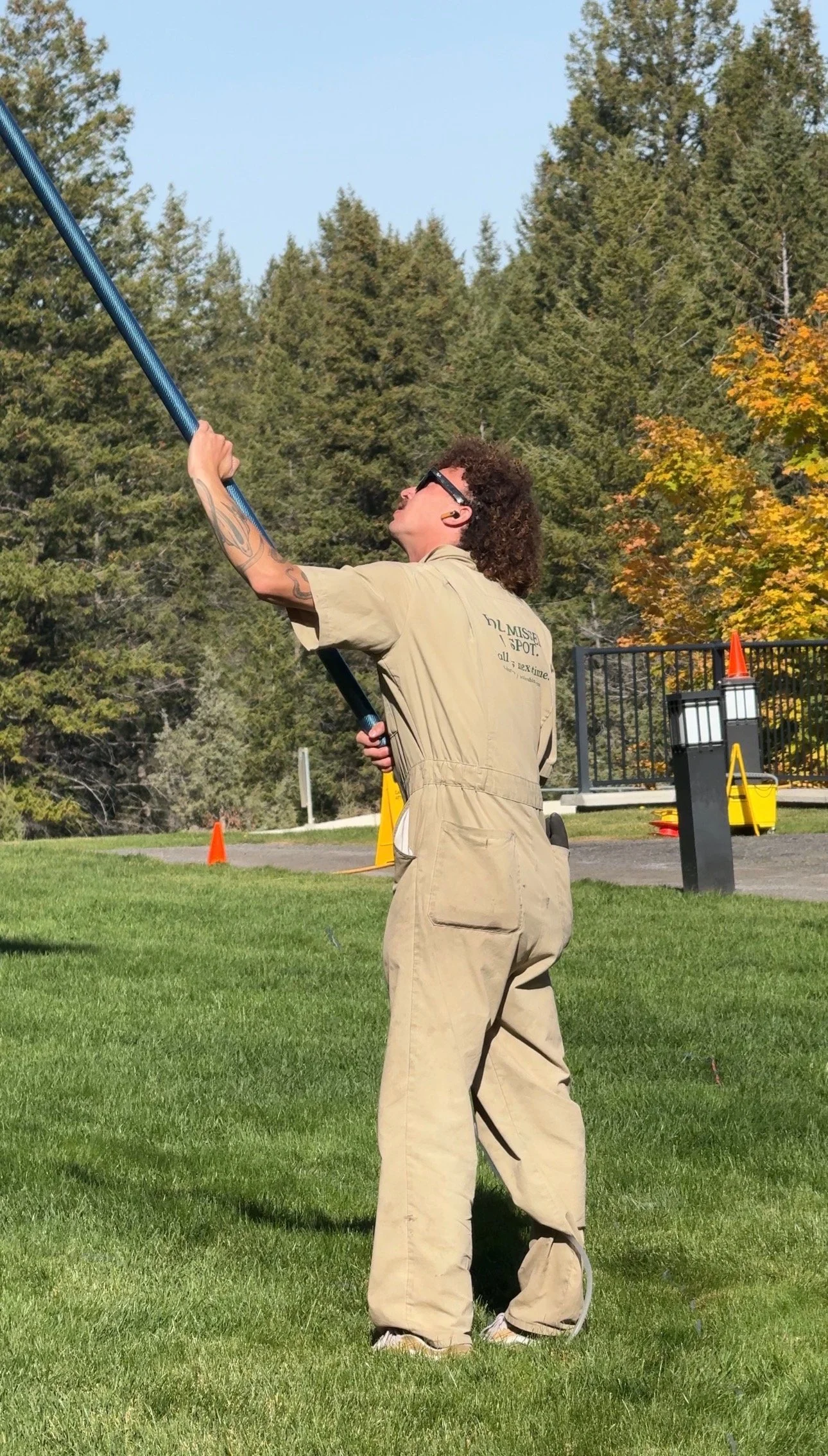
For field execution, the property was divided into three primary production zones.
Each zone represented a defined portion of the resort that could be communicated to hotel operations, serviced systematically, and closed out before the crew advanced.
The zone-based approach created several benefits:
- Resort staff knew where the crew would be working
- Guests in affected areas could receive advance notice
- Equipment could be staged more intentionally
- Hose routes could be planned before production began
- Completed sections were easy to identify
- The crew could focus on one defined objective at a time
- The following day's work could be communicated in advance
Breaking a large property into zones also creates accountability. Instead of reporting that the crew had cleaned “most of one side,” we could identify which zone had been completed and which zone would be addressed next.
That clarity is valuable to both the contractor and the property's operations team.
Creating a guest communication plan
One of the most important project deliverables was created before any glass was cleaned.
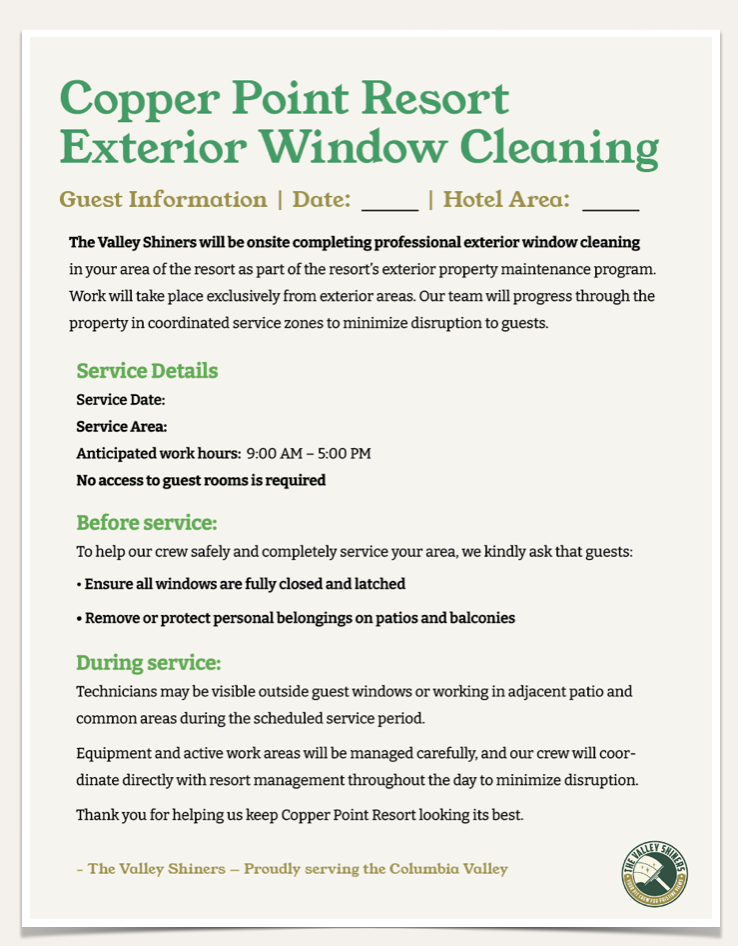
Valley Shiners developed a concise, one-page fillable notice that the resort could distribute to affected guests. The document allowed hotel staff to enter the anticipated date, service zone, and work window for each area.
Guests could be advised that:
- Exterior window cleaning would be taking place
- Technicians might be visible outside rooms, patios, or balconies
- Windows should remain closed and latched
- Belongings sensitive to water should be moved or protected
- Work would be completed as efficiently and respectfully as possible
The notice gave hotel operations a ready-to-use communication tool rather than forcing staff to create one themselves.
It also reduced uncertainty. Guests are generally understanding when they know what is happening, why it is happening, and when it will affect their area. Surprises create complaints; proactive communication helps prevent them.
Maintaining communication throughout the project
Planning the work was only the first step. The resort's operations team also needed visibility while production was underway.
Valley Shiners used its two-way client messaging platform to provide project updates throughout the service. Communications included:
- The active production zone
- Areas completed during the day
- Progress against the planned schedule
- Any access or infrastructure issues encountered
- The area planned for the following day
This allowed hotel operations to coordinate internally without having to locate the crew onsite for every update.
For a large commercial project, this kind of communication is not an administrative extra. It is part of the service.
The property is entrusting a contractor to operate around its employees, customers, and physical infrastructure. Management should not have to wonder where the crew is, what has been completed, or whether the schedule has changed.
The hospitality standard
Clean glass is only one measure of success at an operating resort. The project must also protect guest privacy, minimize disruption, maintain safe access, support hotel staff, and provide management with clear information throughout the work.
The unexpected water-access challenge
The largest technical challenge became clear as the production plan was finalized.
Copper Point Resort is a large property, but only three workable hose spigots were available for the project. Much of the resort's irrigation infrastructure had already been shut down in preparation for freezing temperatures.
Three water sources across a resort of this size created several potential production problems:
- Some work areas were a considerable distance from the nearest spigot
- Normal water pressure could be affected by lengthy hose runs
- Multiple technicians could not simply connect wherever they were working
- Moving between zones required deliberate equipment planning
- A failed water strategy could have delayed the entire schedule
This is one reason pre-project planning and properly equipped commercial crews matter. Large properties frequently present infrastructure conditions that are not obvious during the initial quoting process.
The cleaning contractor must be capable of adapting without transferring the problem back to the client.

How did Valley Shiners work with only three spigots?
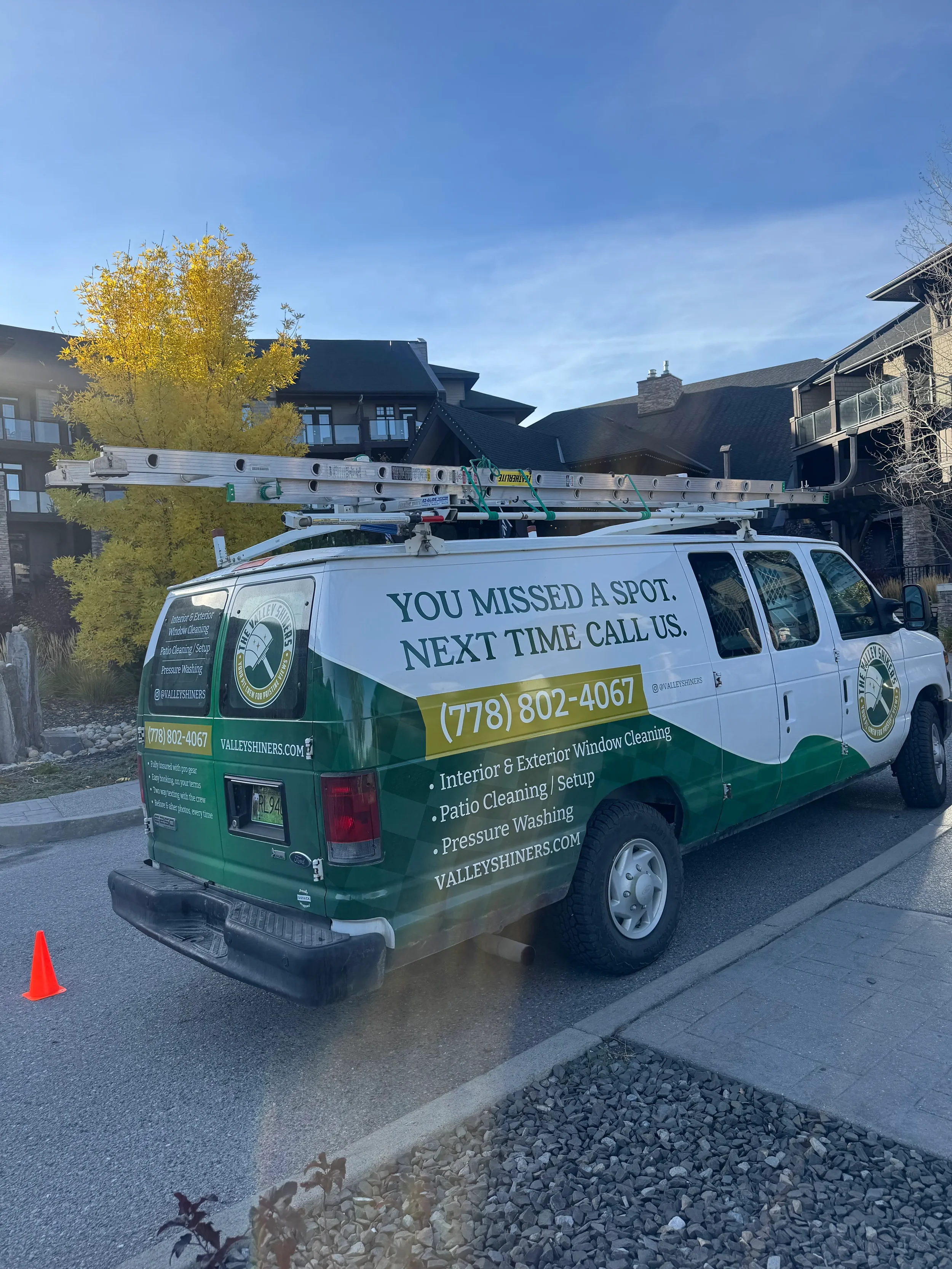
Our crew used a combination of long commercial hose runs, inline pumps, and the onboard water system installed in our service van.
Long commercial hose runs
The available spigots were mapped to the production zones and hoses were routed to reach the required work areas. Routes were selected to reduce their effect on guests and hotel operations.
Where hoses crossed or approached pedestrian areas, the crew remained conscious of trip hazards and repositioned equipment as production moved.
Inline water pumps
Long hose runs can reduce the pressure available to commercial water-purification equipment. Inline pumps were used where necessary to maintain workable flow and keep the crew productive at greater distances from the water source.
Onboard van water
Our van-mounted water system provided an additional source when conventional access was limited or impractical.
This gave the crew the ability to continue producing rather than stopping while a new connection was located or waiting for infrastructure to become available.
The combination of these systems allowed Valley Shiners to work through the property's water limitations without extending the project beyond the planned production window.
Why is RO/DI pure water used for resort window cleaning?
The project was completed using commercial reverse-osmosis and deionization systems, commonly referred to as RO/DI pure-water systems.
Municipal and well water contain dissolved minerals. If ordinary water is allowed to dry on glass, those minerals can remain behind as visible spotting.
An RO/DI system filters dissolved solids from the water before it reaches the glass. The purified water is delivered through professional water-fed poles, allowing technicians to scrub the glass and surrounding frames before completing a final purified-water rinse.
When the glass is properly cleaned and rinsed, the purified water can dry without leaving the mineral residue associated with untreated water.
For a property like Copper Point Resort, water-fed pole systems provide several advantages:
- Technicians can clean elevated exterior glass from the ground
- The crew can move efficiently across large banks of windows
- Frames and glass can be cleaned together
- Ladder use can be reduced in suitable areas
- Production can continue systematically across hundreds of panes
- Multiple technicians can work simultaneously in a coordinated pattern
The equipment creates capacity, but equipment alone does not manage a resort project. The production plan, crew coordination, and client communication are what allow that capacity to be used effectively.


Protecting guests and resort operations
Every work area was approached as an active hospitality environment—not merely a cleaning site.
That meant the crew needed to remain aware of:
- Guest-room privacy
- Open windows and patio doors
- People entering or leaving the property
- Guests using patios, pools, and common spaces
- Hoses near walking routes
- Water around entrances
- Equipment staged in visible areas
- The appearance and conduct of the crew
- Noise and conversation around occupied rooms
Technicians moved equipment as the active zone changed rather than allowing unnecessary gear to spread across the property.
High-traffic areas required additional awareness and timely completion. Work could not be allowed to linger around entrances or guest-facing spaces simply because those areas were convenient places to stage equipment.
Our goal was to be visible when necessary, professional at all times, and largely forgettable to the guests whose vacations were happening around us.
Crew structure and production
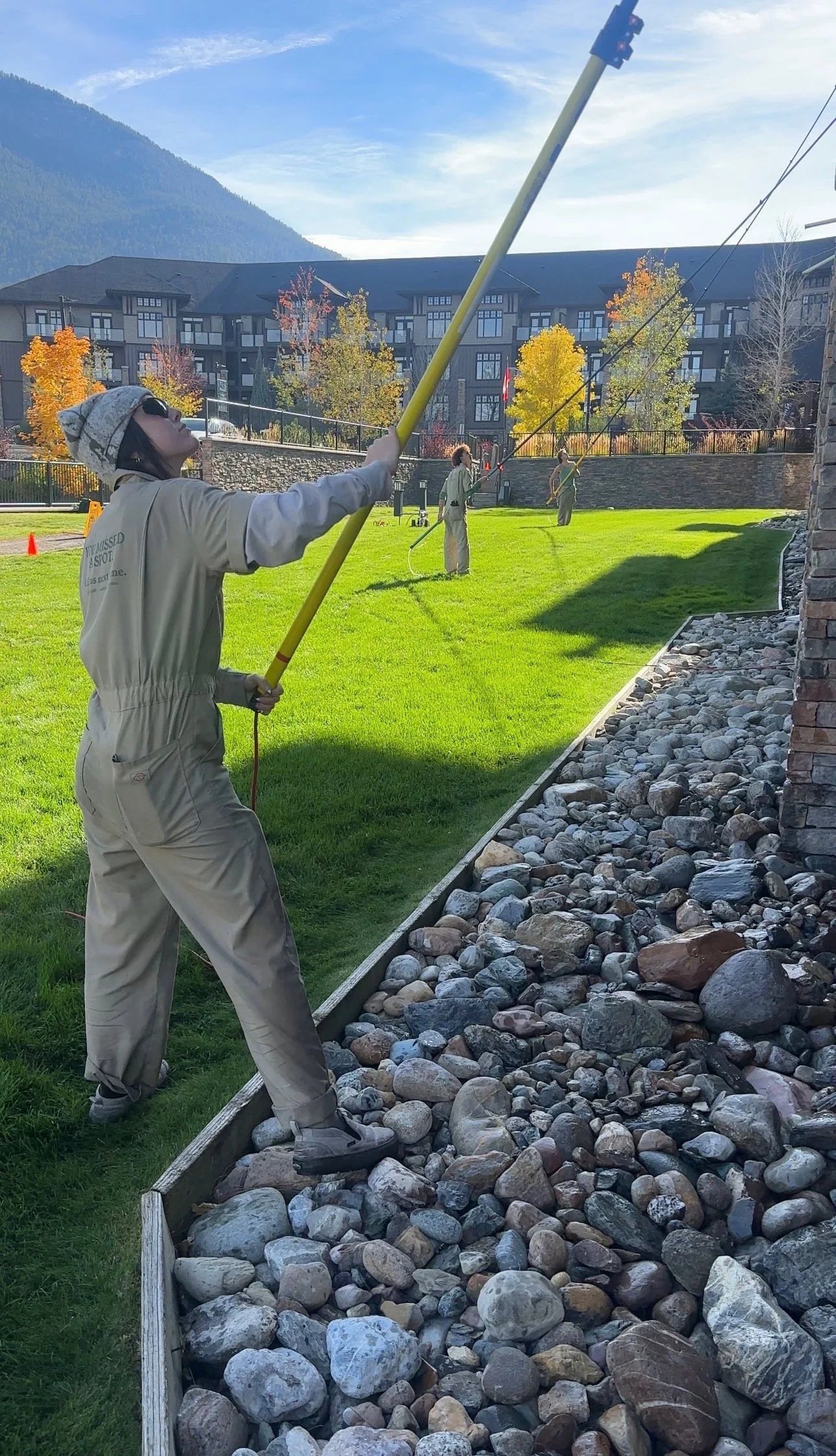
The Copper Point Resort project was completed by a four-person Valley Shiners crew.
Multiple technicians allowed the team to operate more than one pure-water system, progress through large window elevations, and manage long hose runs without sacrificing production.
The crew followed the predefined zones rather than separating into disconnected work areas. This helped maintain:
- Consistent direction
- Equipment control
- Clear progress tracking
- Better awareness of completed and outstanding glass
- Faster movement between work areas
- More reliable communication with hotel operations
Over two and a half production days, the crew cleaned more than 1,000 window panes across the resort.
That represents an average of more than 400 panes per full production day, although actual output varied by access, window configuration, hose placement, and guest activity.
Pane count alone should never be treated as a universal productivity formula. A ground-level commercial pane beside a convenient water source is fundamentally different from glass located above a guest patio at the far end of a resort.
The relevant measurement is whether the contractor can combine speed, consistency, safety, and operational awareness.
The outcome: 1,000+ panes, 2.5 days, and zero guest complaints
The fall window-cleaning project was completed ahead of Copper Point Resort's busy Thanksgiving weekend.
The final results included:
- More than 1,000 exterior window panes cleaned
- Three planned production zones completed
- Four technicians coordinated onsite
- Two and a half days of production
- Resort operations maintained throughout
- Water-access limitations successfully overcome
- Regular progress updates provided to hotel operations
- Zero guest complaints
That final result deserves emphasis.
A guest complaint is not inevitable during a large resort cleaning project. With advance communication, disciplined crew movement, and coordination with hotel operations, substantial exterior maintenance can be completed while the property remains active.
The absence of complaints was not accidental. It was the product of the systems surrounding the cleaning itself.

The result that mattered most
More than 1,000 panes were cleaned while Copper Point Resort remained open and occupied. According to the resort's operations team, the entire project was completed without generating a single guest complaint.
What made the Copper Point Resort project successful?
1. A dedicated site walk
The crew did not discover the entire property for the first time on production day. Access, water sources, guest-facing areas, and equipment locations had already been assessed.
2. A clear zone plan
Dividing the property into three production zones gave the crew defined objectives and gave resort management visibility into the schedule.
3. Proactive guest communication
The fillable notice allowed affected guests to understand when technicians would be working near their rooms or patios.
4. Continuous operational updates
Hotel management received information about completed areas, active work, and the following day's plan.
5. Redundant water capability
Long hoses, inline pumps, and onboard van water allowed the crew to adapt when most exterior water sources were unavailable.
6. An appropriately sized crew
Four technicians created enough production capacity to complete a large scope without unnecessarily extending the disruption.
7. Respect for the hospitality environment
The team understood that this was not an empty building. It was a resort full of people enjoying their time in the Columbia Valley.
What should hotels look for in a commercial window-cleaning contractor?
Large hospitality properties should assess more than price and basic cleaning ability.
Before awarding a project, hotel and resort operators should ask:
- Has the contractor completed work in active commercial or hospitality environments?
- Can the contractor provide enough trained technicians for the required schedule?
- Who will act as the onsite crew lead?
- How will the property be divided into work areas?
- How will guests and staff be notified?
- How will daily progress be reported?
- What happens if water sources are unavailable?
- Does the contractor have commercial RO/DI equipment and backup capability?
- How will hoses and equipment be managed around guests?
- Can the contractor distinguish maintenance cleaning from mineral restoration?
- What insurance and safety documentation can the contractor provide?
- How will the project be inspected and closed out?
A large project should not depend on ideal conditions. The contractor should arrive with a plan and possess enough operational flexibility to respond when the property does not behave exactly as expected.
A commercial cleaning project is an operational project
The Copper Point Resort case study demonstrates an important distinction.
Cleaning ability is essential, but large-scale hospitality work also requires planning, communication, crew coordination, and problem-solving.
More than 1,000 panes needed to be cleaned. At the same time, guests needed to enjoy their stays, staff needed to operate the resort, and management needed confidence that the project was progressing according to plan.
The limited water access could have created significant delays. The active guest environment could have produced complaints. The size of the property could have made communication unclear.
Instead, the resort was divided into manageable zones, guests were notified, operations received regular updates, and the crew adapted its equipment strategy to the conditions onsite.
The result was a cleaner resort, a completed schedule, and no disruption significant enough to generate a single guest complaint.
Planning a hotel or resort window-cleaning project?
Hotels • Resorts • Strata communities • Property managers • Facility teams • Restaurants • Conference properties • Commercial buildings
Valley Shiners provides coordinated commercial window cleaning and exterior property maintenance throughout the Columbia Valley. Large hospitality and multi-building projects can also be assessed elsewhere in the Kootenays when the scope requires a dedicated commercial crew.
FAQ: Hotel and resort window cleaning
Can hotel windows be cleaned while guest rooms are occupied?
Yes. Exterior resort window cleaning can be completed while rooms remain occupied, provided guests receive advance notice, windows are closed and latched, patio belongings are protected, and technicians work respectfully around occupied spaces. The contractor and hotel operations team should agree on work zones and communication procedures before production begins.
How long does it take to clean 1,000 hotel window panes?
Production time depends on glass configuration, height, access, environmental buildup, water availability, and guest activity. At Copper Point Resort, a four-person Valley Shiners crew cleaned more than 1,000 exterior panes in two and a half days.
How many technicians are required for a large resort window-cleaning project?
Crew size should reflect the pane count, access requirements, deadline, and operational complexity. A crew that is too small may extend disruption across too many days, while a larger crew without a coordinated plan can create unnecessary congestion. Copper Point Resort was completed by four technicians working within one shared production plan.
How should hotel guests be notified about exterior window cleaning?
Guests should receive a concise notice identifying the anticipated service date, work window, and affected area. They should be asked to close and latch windows and protect water-sensitive patio belongings. Valley Shiners created a fillable one-page notice that Copper Point Resort could distribute by production zone.
What happens if a resort has limited exterior water access?
A qualified commercial contractor should assess water availability before the project and arrive with appropriate contingencies. At Copper Point Resort, only three workable spigots were available after the irrigation system had been winterized. Valley Shiners used long commercial hose runs, inline pumps, and an onboard van water system to maintain production.
Can a commercial window-cleaning company bring its own water?
Yes. An onboard water system can supplement available building water and support production in areas where conventional connections are limited or impractical. The amount of water required depends on the scope, equipment, and available refill options.
Why is RO/DI pure water used for commercial window cleaning?
RO/DI systems remove dissolved minerals from the water before it reaches the glass. When a window is properly scrubbed and rinsed with purified water, it can dry without leaving the mineral spotting associated with untreated water.
Does pure-water window cleaning remove existing mineral staining?
Not always. Pure-water maintenance cleaning removes ordinary dirt and environmental residue, but bonded mineral deposits may require a separate restoration process, specialized chemistry, additional agitation, and separate pricing.
How can a hotel reduce complaints during exterior maintenance?
Advance notice is the first step, but execution also matters. The contractor should work within defined zones, keep management informed, control hoses and equipment, move efficiently through high-traffic areas, and remain conscious of guest privacy. Copper Point Resort remained occupied throughout the project and received zero guest complaints related to the work.
What should a hotel provide before window cleaning begins?
Hotel operations should identify a primary contact, confirm accessible water sources, advise the contractor of high-traffic areas or special events, distribute guest notices, ensure affected windows are closed, and communicate any restricted areas before production begins.
What should hotels look for in a commercial window-cleaning contractor?
Hotels should look for adequate crew capacity, commercial RO/DI equipment, appropriate insurance and safety procedures, a defined onsite leader, guest-communication planning, operational progress updates, backup water capability, and demonstrated experience working around active customers and staff.
Does Valley Shiners clean windows at other hotels, resorts, and commercial properties?
Yes. Valley Shiners provides coordinated commercial window cleaning and exterior property maintenance for hotels, resorts, strata communities, restaurants, and other commercial properties throughout the Columbia Valley. Large projects elsewhere in the Kootenays can also be assessed individually.
