
How We Treated Established Roof Moss on an Asphalt-Shingle Roof in Windermere, BC
The Valley Shiners serves homes, cottages, golf courses, strata councils, hospitality properties, storefronts, and commercial buildings across Invermere, Windermere, Radium, Fairmont, and Panorama.
Roof Moss Treatment • Asphalt-Shingle Roof Case Study
Established moss on an asphalt-shingle roof should not necessarily disappear on the day it is treated.
When moss has grown into dense clumps or established itself beneath the edges of shingles, attempting to create an immediate cosmetic transformation can damage the roofing material the service is intended to protect.
The safer objective is to arrest the organic growth, allow the treatment time to work, and let normal weather gradually release the dead material from the roof.
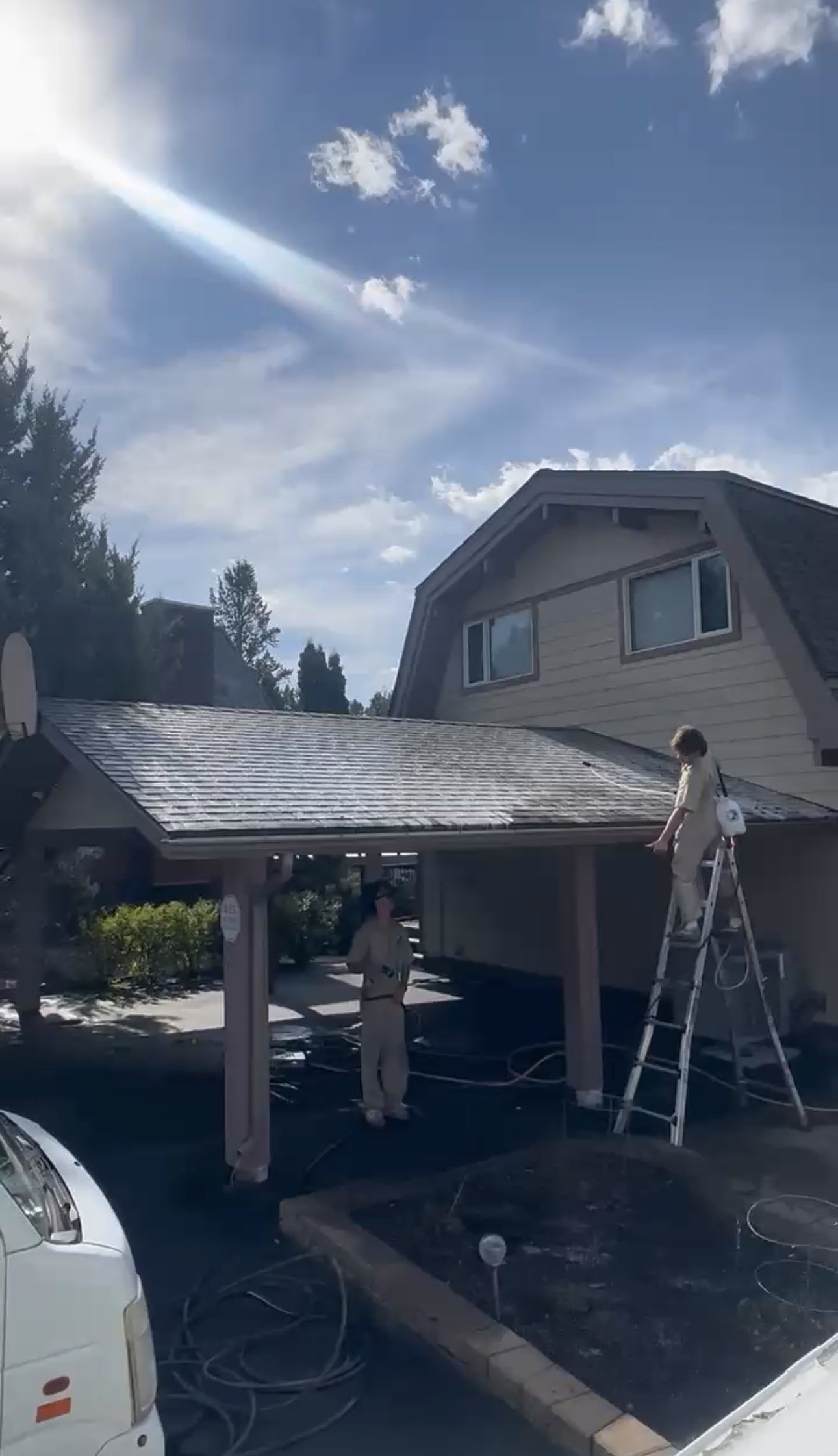
Valley Shiners recently completed the first two stages of a targeted roof moss treatment for a homeowner in Terravista, a lakefront community in Windermere, British Columbia.
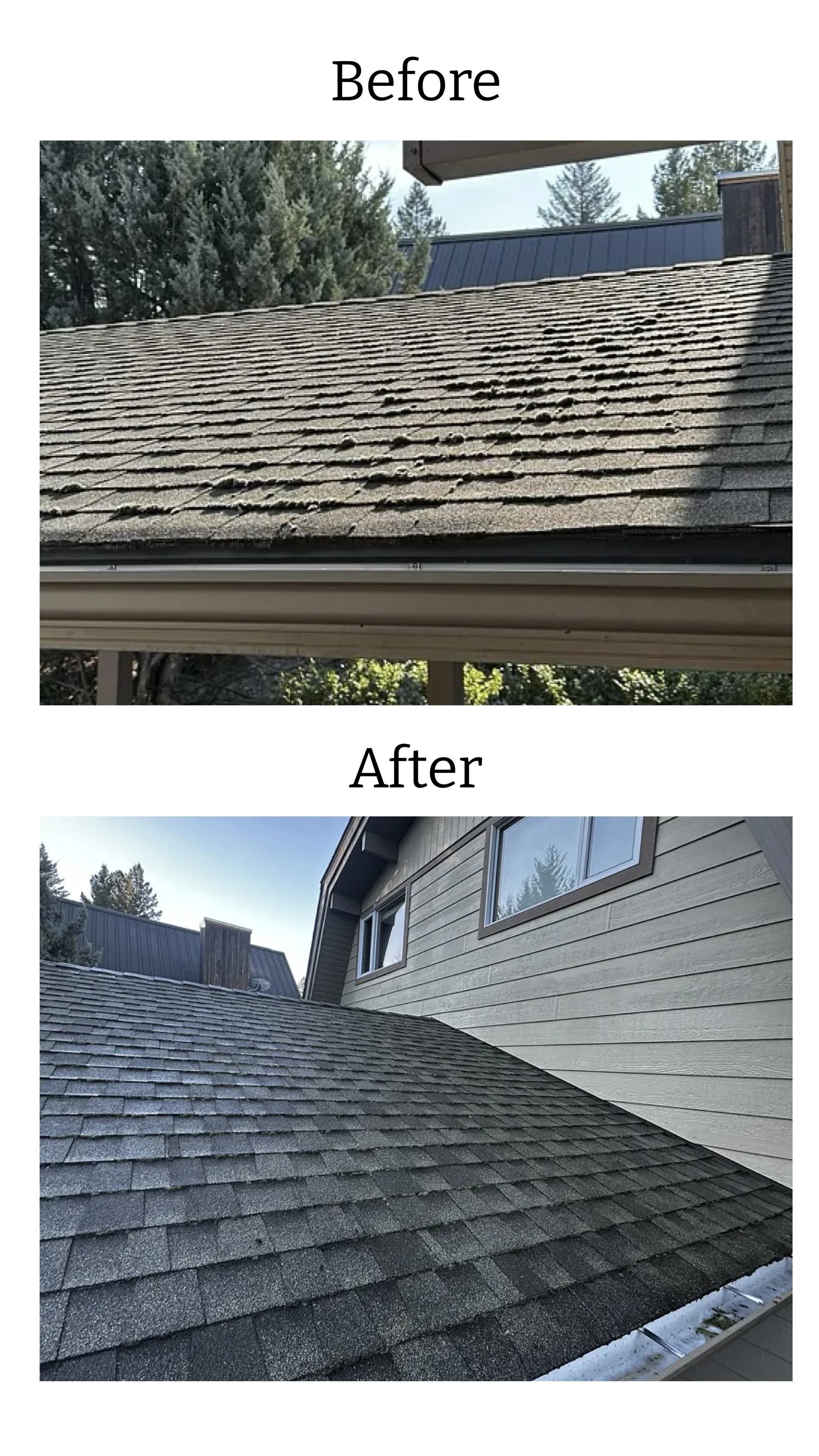
The asphalt-shingle roof had significant moss, lichen, and organic buildup in several concentrated areas. The growth did not affect the entire roof, but some of the heaviest sections had become firmly established beneath the lower edges of the shingles.
Rather than treating the project as an instant moss-removal service, we developed a multi-stage plan focused on protecting the roof, treating the active growth, monitoring its response, and returning in the spring to verify the final result.
Project Snapshot
Property: Private residence
Location: Terravista, Windermere, British Columbia
Roof type: Asphalt shingles
Primary concern: Established moss, lichen, and organic buildup
Distribution: Significant growth in targeted roof sections rather than across the entire roof
Condition: Moss had become established beneath some shingle edges
Initial approach: Assessment, preparation, limited safe agitation, and low-pressure treatment
Follow-up: Inspection and targeted second treatment approximately one week later
Observed response: Significant visible die-off during the first week
Current stage: Allowing dead growth to release naturally through seasonal weather
Next step: Confirmed spring inspection and targeted retreatment if living growth remains
Primary objective: Arrest the organic growth while protecting the asphalt shingles
The problem: concentrated moss growth on part of the roof
This property did not require a blanket treatment across every roof surface.
Several lower and more accessible sections—including areas around the carport, deck overhangs, and adjoining rooflines—had accumulated substantial organic growth. Other areas of the roof showed little or no comparable buildup.
This uneven distribution is common. Moss growth is influenced by shade, moisture retention, roof orientation, nearby trees, airflow, roof geometry, and the amount of sunlight reaching each section.
A roof can therefore have one heavily affected elevation while another remains relatively clear.
On this property, the most established moss had formed thick patches and extended beneath portions of the shingle edges. Lichen and other organic material were also present within the affected areas.
Once growth reaches this stage, the project requires more care than simply brushing visible material from the surface.
Why moss beneath shingle edges requires a cautious approach
Asphalt shingles are designed to shed water in overlapping courses. Their performance depends on the condition of the shingles, their surface granules, the integrity of their edges, and the way they remain seated against the roof.
Established moss can retain moisture and gradually work into the spaces around shingle edges. Dense growth may also lift or distort portions of the roofing material over time.
That does not mean the safest solution is to pull the moss out immediately.
Aggressive scraping, stiff brushing, high-pressure washing, or forcefully lifting moss from beneath shingles can remove protective granules, disturb aging material, loosen edges, and introduce water where it should not go.
The central question is therefore not:
“How quickly can every visible piece of moss be removed?”
The more useful question is:
“How can the growth be stopped and released without causing unnecessary damage to the roof?”
That distinction shaped the entire project.
A roof treatment—not an instant cosmetic cleaning
Valley Shiners approached this project as a roof moss treatment intended to protect the shingles, not as a same-day cosmetic transformation.
The purpose of the initial service was to:
- Assess the location and severity of the organic growth
- Identify which roof sections could be serviced safely
- Remove loose material where it could be released without force
- Apply treatment directly to the affected moss and lichen
- Allow time for the treatment to penetrate established growth
- Return to evaluate the response rather than assuming one application was sufficient
- Protect the asphalt shingles from unnecessarily aggressive cleaning
This approach requires more patience than pressure washing or intensive scraping, but it respects the fact that the roof itself is more important than an immediate before-and-after photograph.
The treatment principle
Established roof moss should be treated as a biological growth problem—not simply a layer of dirt. The objective is to stop the growth first, then allow dead material to release gradually without damaging the shingles beneath it.
Stage 1: assessment, preparation, and initial treatment
The first visit began with an onsite assessment of the affected roof sections.
We reviewed the roof material, access conditions, distribution of moss, surrounding property features, and the relationship between the organic growth and the shingle edges.
Because the growth was concentrated rather than roof-wide, the service could be directed toward the problem areas instead of applying an unnecessary blanket process to unaffected surfaces.
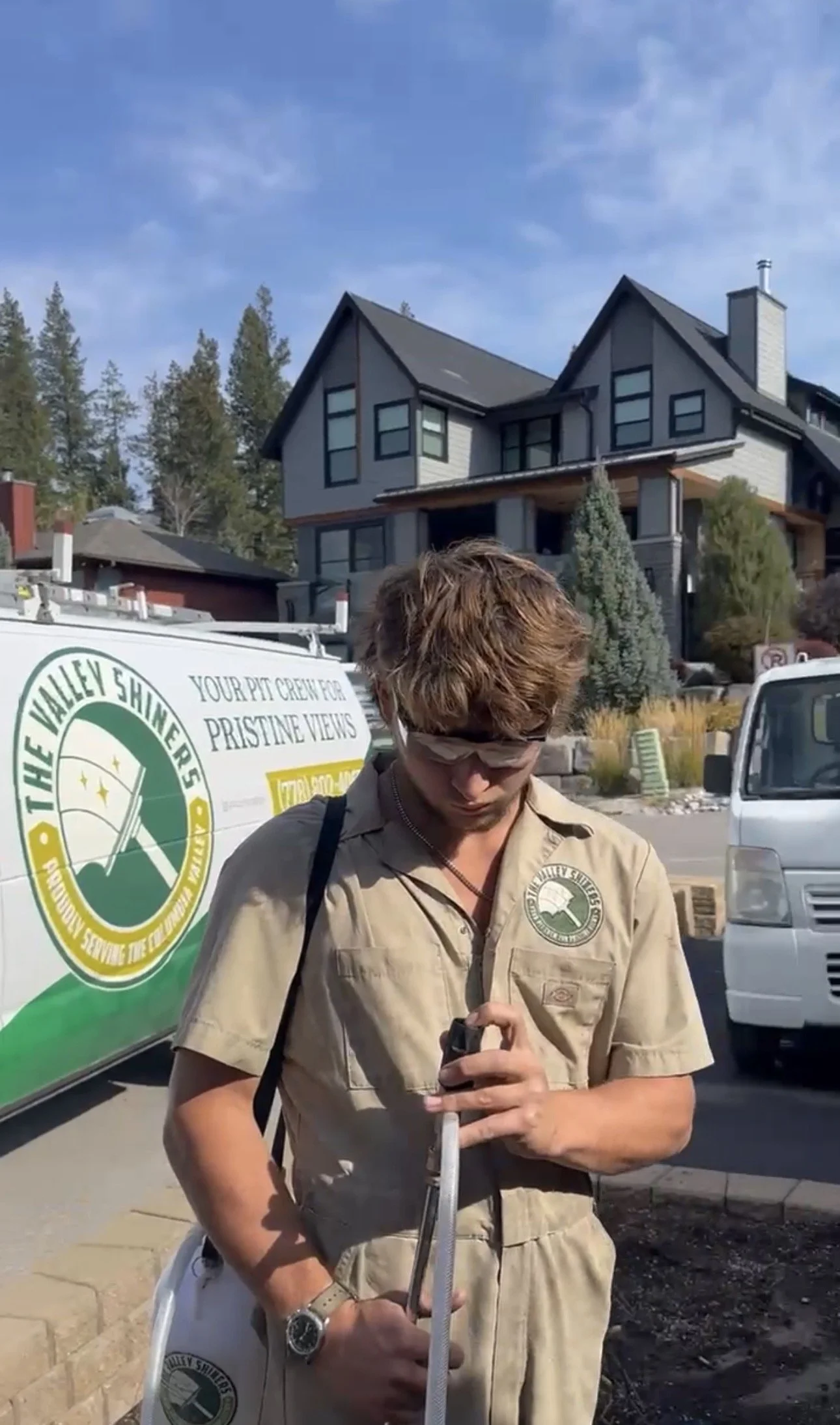
Before treatment, the crew prepared the work area and protected surrounding surfaces as required. Loose debris and moss were removed where they could be released safely, and limited soft-bristle agitation was used only where appropriate.
We deliberately avoided trying to force firmly attached material from beneath the shingles.
The treatment solution was then applied at low pressure to the affected areas. The objective was thorough contact with the moss and lichen without using destructive water pressure against the roof.
What should moss look like after treatment?
Treated moss does not always disappear immediately.
One of the earliest signs that a treatment is working is a change in colour and condition. Depending on the moss species, moisture level, weather, and density of growth, treated material may begin turning:
- Pale green
- White or grey
- Yellow or tan
- Brown
- Dry, brittle, or visibly collapsed
These changes indicate that the organic material is responding, even though it may remain physically attached to the roof.
This can be confusing for homeowners expecting the roof to look completely clear at the end of the initial visit. Moss treatment is often successful biologically before the full cosmetic result becomes visible.
Killing or arresting the growth and removing every trace of dead material are two different stages.
Stage 2: follow-up inspection and targeted second treatment
Valley Shiners returned approximately one week after the initial service.
This follow-up was an important part of the project rather than an afterthought. It allowed us to evaluate how the moss had responded and identify areas where the first application had not fully penetrated the most established growth.
During the follow-up inspection, we observed significant improvement. Much of the moss had already begun to die, with clear changes in colour, density, and overall condition.
Some of the heaviest organic buildup required additional attention. A more concentrated treatment was applied selectively to those areas rather than repeating the entire original scope indiscriminately.
This targeted second application gave the remaining growth additional treatment while continuing to prioritize the condition of the shingles.
Why might established roof moss require a second treatment?
Moss does not always grow as a thin, uniform layer.
Dense colonies can contain overlapping material, trapped debris, and lower layers shielded from the first application. Growth beneath shingle edges may also be more difficult to reach than exposed surface moss.
A staged service allows the contractor to evaluate the actual response before deciding whether additional treatment is appropriate.
This is more controlled than assuming the strongest possible initial application should be used everywhere. Treatment can be adjusted according to the condition of the roof and the behaviour of the remaining growth.
A follow-up visit can help determine:
- Whether the moss is changing colour and visibly deteriorating
- Whether dense sections require additional treatment
- Whether any areas were shielded during the initial application
- Whether loose dead material can now be released safely
- Whether the roof should simply be left to weather naturally
- Whether any suspected roofing concerns should be referred to a roofer
The complete roof moss treatment process
A responsible moss-treatment process extends beyond the day the solution is applied.
The visual guide below illustrates the expected progression from active moss growth through treatment, visible die-off, natural release, and long-term verification.
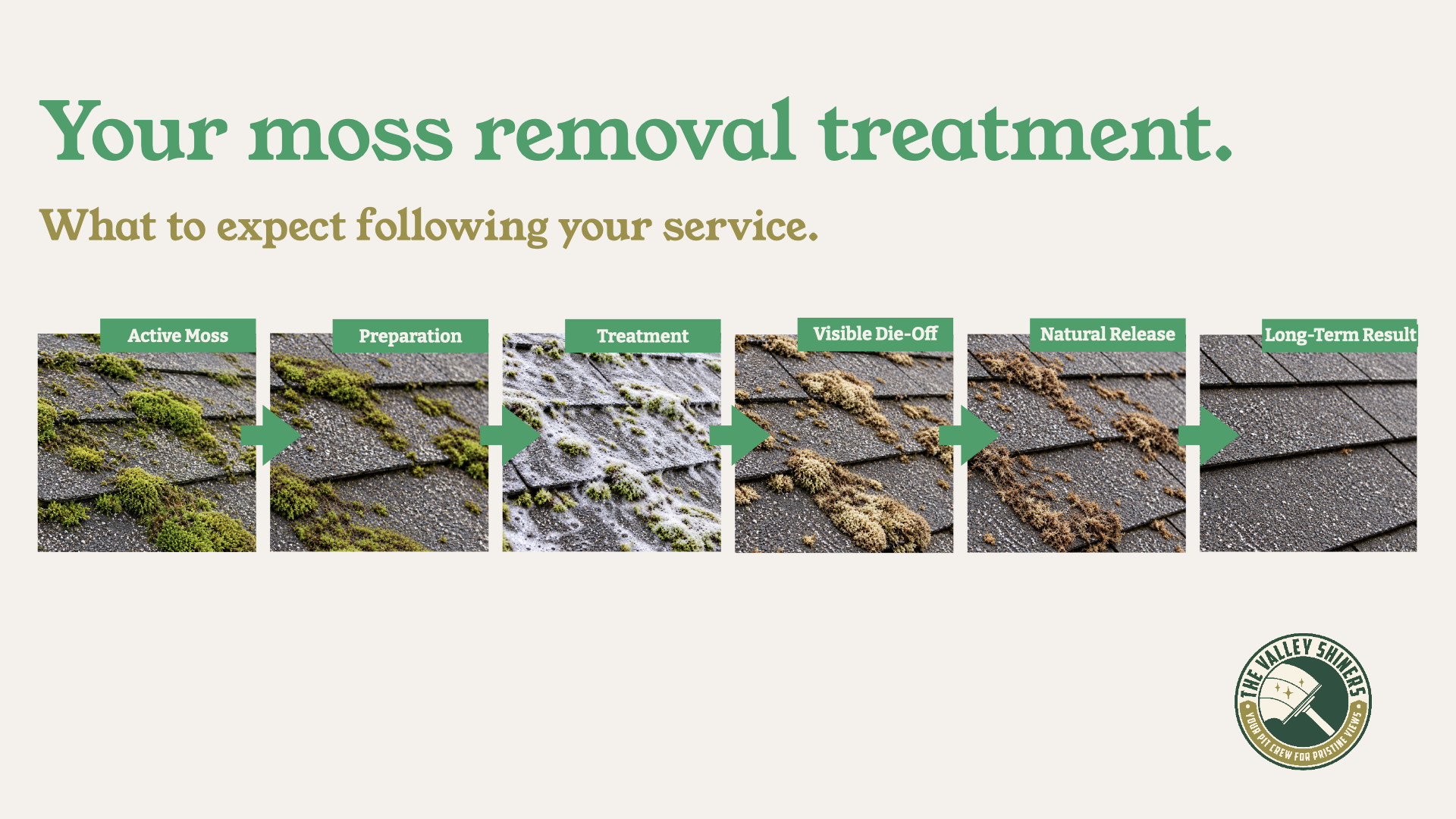
1. Active moss and lichen are assessed
The roof is evaluated to determine where growth is present, how deeply it has become established, which sections can be treated safely, and whether the condition falls within a cleaning scope.
2. Loose material is prepared
Debris and moss that can be removed without force may be cleared using roof-appropriate methods. Firmly attached material is not aggressively scraped from the shingles.
3. Treatment is applied
The affected areas receive a controlled, low-pressure application intended to contact and arrest the organic growth.
4. Visible die-off begins
Moss may change colour, lose density, dry out, and begin deteriorating. This stage can begin relatively quickly, but the material may remain attached.
5. Weather gradually releases dead material
Rain, wind, snow, and normal freeze-thaw cycles help loosen and remove dead organic material over time.
6. The roof is inspected again
A follow-up inspection confirms whether the growth has been successfully arrested and identifies any isolated areas that may require further treatment.
Stage 3: allowing nature to release the dead moss
After the second treatment, the roof entered the natural weathering stage.
Much of the affected moss had already visibly deteriorated, but some dead material remained attached to the shingles. At this stage, the safest course was not to force an immediate removal.
Normal weather will continue doing much of the work.
Rain can rehydrate and loosen deteriorating material. Wind can carry away lighter fragments. Snow and seasonal freeze-thaw cycles can gradually weaken the attachment between dead moss and the roof surface.
This process may take weeks or months depending on:
- The original depth and density of the moss
- How far it had extended beneath shingle edges
- The amount of shade and moisture on the affected roof section
- Roof pitch and drainage
- Seasonal precipitation and temperature changes
- The age and condition of the shingles
A slower cosmetic result does not necessarily mean the treatment has failed. The condition of the moss—not simply whether every trace remains visible—is what indicates whether the process is working.
What the homeowner should expect
Roof moss treatment is a progression rather than a single visual event. The growth may die quickly but remain visible while it dries, deteriorates, and gradually releases from the shingles. Protecting the roof takes priority over forcing an immediate cosmetic result.
Stage 4: a confirmed spring inspection
The project is not being treated as complete simply because the initial applications have been performed.
The homeowner is already pre-booked and confirmed for a spring inspection.
By spring, the roof will have experienced several months of rain, snow, wind, and freeze-thaw conditions. This will provide a much clearer view of how thoroughly the dead moss has released and whether any living growth remains.
During the spring visit, Valley Shiners will:
- Inspect the previously treated roof sections
- Confirm whether the moss and lichen remain inactive
- Evaluate how much dead material has released naturally
- Identify any isolated areas that may require additional attention
- Apply targeted retreatment if living growth remains within the approved scope
- Document the long-term result for the homeowner
This visit will allow us to verify whether the treatment was fully successful rather than declaring a final outcome prematurely.
Why pressure washing was not used
Pressure washing can create a dramatic same-day change, but asphalt shingles are not concrete.
Excessive pressure can dislodge protective granules, disturb shingle edges, drive water beneath the roofing material, and accelerate wear on an already aging roof.
Pressure may remove the visible upper portion of the moss while leaving organic material within protected gaps and beneath shingle edges. It can therefore create the appearance of a completed service without necessarily addressing the entire biological problem.
For this project, low-pressure treatment and controlled agitation offered a more appropriate balance between effectiveness and roof protection.
Why aggressive scraping was also avoided
Scraping firmly established moss from an asphalt roof can create many of the same risks as excessive water pressure.
When moss is intertwined with shingle edges, forcing a tool beneath it may also lift the roofing material. Stiff brushes can remove surface granules, while aggressive movement across the roof can create additional wear.
Valley Shiners removed or disturbed material only where it could be done responsibly. Heavily attached growth was treated and left to deteriorate rather than being pulled out for the sake of an immediate visual result.
Why the entire roof was not treated
The organic growth on this property was localized.
Treating the entire roof would have expanded the scope without necessarily creating a meaningful benefit. The approved project concentrated on the areas where moss and lichen were visibly established and where access conditions allowed the work to be completed appropriately.
Targeted treatment can be the right choice when:
- Moss is concentrated on shaded or moisture-retaining elevations
- Large portions of the roof remain clear
- The affected areas can be isolated and accessed safely
- The homeowner wants to address active growth before it spreads further
- A focused treatment offers better value than an unnecessary roof-wide application
The appropriate scope should be based on observed conditions rather than an assumption that every roof requires the same process.
What made this a premium, multi-stage service?
The value of this project was not limited to applying a treatment solution.
The service included:
- An initial onsite assessment
- A scope tailored to the affected roof sections
- Preparation and protection of surrounding property features
- Low-pressure application suited to an asphalt-shingle roof
- Limited, controlled agitation where appropriate
- A scheduled follow-up approximately one week later
- Evaluation of the moss response before further treatment
- A more concentrated second application where required
- Clear expectations regarding natural release and the cosmetic timeline
- A confirmed spring inspection to verify the long-term result
- Targeted retreatment if living growth remains within the agreed scope
A lower-cost, one-visit service might apply a product and leave the homeowner to interpret the result alone.
Our approach was designed to provide a managed process with assessment, follow-through, and verification.
The current result
The first-week response was encouraging.
A significant portion of the moss showed visible deterioration after the initial application. The follow-up visit allowed the remaining concentrated growth to receive additional treatment before winter.
The roof is now in the natural-release stage. Dead material remains visible in places, which is expected at this point in the process.
We will not describe the project as a complete long-term success until the scheduled spring inspection confirms that the living growth has been arrested and the roof has progressed as expected.
That ongoing accountability is an important part of the service.
What should homeowners know before booking roof moss treatment?
Homeowners should enter a moss-treatment project with realistic expectations about both the process and the timeline.
Important considerations include:
- A roof assessment should come before the cleaning method is selected
- Not every roof or roof section can be accessed safely
- Established moss may require more than one application
- Visible die-off can occur before the moss physically releases
- The full cosmetic improvement may take weeks or months
- Pressure washing is generally not an appropriate default for asphalt shingles
- Cleaning cannot reverse pre-existing shingle deterioration
- A cleaning contractor should not represent themselves as a roofing contractor
- Suspected leaks, loose shingles, structural concerns, or advanced roof failure should be referred to a qualified roofer
- A follow-up inspection provides more certainty than a one-visit application
Roof moss treatment in Windermere and the Columbia Valley
Roof moss is a localized but recurring maintenance concern in the Columbia Valley.
Properties near the lake, mature trees, irrigated landscaping, shaded rooflines, and moisture-retaining areas may experience substantially more organic growth than nearby roofs with better sun exposure and airflow.
Valley Shiners assesses roof moss treatment projects in Windermere, Invermere, Fairmont Hot Springs, Radium Hot Springs, and surrounding Columbia Valley communities.
Each property is evaluated according to the roof material, growth severity, access conditions, surrounding surfaces, and the limits of a responsible exterior-cleaning scope.
Treatment may be appropriate for localized or widespread moss and lichen, but we do not assume every roof should be approached in the same way.
Questions to ask a roof moss treatment contractor
Before authorizing a roof moss service, consider asking:
- Will the roof be assessed before the treatment method is selected?
- Is the service intended to kill the growth or remove everything immediately?
- Will pressure washing be used on the asphalt shingles?
- How will firmly attached moss beneath shingle edges be handled?
- How will siding, decks, landscaping, and runoff areas be protected?
- What should the moss look like after treatment?
- How long should natural release take?
- Is a follow-up inspection included?
- What happens if some areas remain alive after the first application?
- Which roof sections are included, and are any areas excluded because of access or condition?
- Will suspected roofing defects be documented and referred to an appropriate roofer?
Clear answers to these questions help separate a controlled roof-treatment process from an aggressive cosmetic cleaning.
Concerned about moss on your roof?
Asphalt-shingle roofs • Targeted moss treatment • Lichen treatment • Organic buildup • Follow-up inspections
Send Valley Shiners photographs of the affected roof areas, your property location, and any known access concerns. We can help determine whether the project appears suitable for treatment and whether an onsite assessment is required.
FAQ: Roof moss treatment in Windermere, BC
Should moss disappear immediately after a roof treatment?
Not necessarily. Treated moss may change colour and begin deteriorating relatively quickly while remaining physically attached to the shingles. Rain, wind, snow, and freeze-thaw cycles can then help release the dead material over the following weeks or months.
How can I tell whether roof moss treatment is working?
Treated moss often becomes pale, white, grey, yellow, tan, or brown. It may lose density, become brittle, or visibly collapse. These changes can indicate die-off even when the dead material remains visible on the roof.
How long does it take for dead moss to come off a roof?
The timeline varies. Light growth may release relatively quickly, while dense moss established beneath shingle edges may take several months. Roof exposure, pitch, seasonal weather, shade, moisture, and the condition of the shingles all affect the process.
Can moss be pressure washed from asphalt shingles?
Aggressive pressure washing is generally not the preferred approach for asphalt shingles. Excess pressure can remove protective granules, disturb shingle edges, drive water beneath the roofing material, and accelerate wear. A low-pressure treatment process is usually more appropriate.
Can roof moss be scraped off?
Loose material may sometimes be removed carefully, but firmly attached moss should not automatically be scraped away. Aggressive scraping and stiff brushing can disturb granules, lift shingle edges, and damage aging roofing material.
Why does moss grow more heavily on one section of a roof?
Moss growth is influenced by shade, moisture, nearby trees, roof orientation, airflow, drainage, and the amount of sunlight reaching each roof section. One elevation may develop significant growth while another remains relatively clear.
Does the entire roof need to be treated?
Not always. If moss is concentrated in specific areas, a targeted treatment may be appropriate. The final scope should reflect the location of the growth, roof condition, access, and whether unaffected sections would receive any meaningful benefit from treatment.
Why might roof moss need a second treatment?
Dense moss can contain overlapping layers, trapped debris, or protected growth beneath shingle edges. A follow-up inspection can identify areas that did not receive complete treatment during the initial application and allow those sections to be addressed selectively.
Will moss treatment repair damage already caused to the roof?
No. Moss treatment can address organic growth, but it cannot replace missing granules, reseal loose shingles, repair leaks, or reverse pre-existing deterioration. Roofing defects should be assessed and repaired by a qualified roofing contractor.
Is a spring inspection useful after a fall roof moss treatment?
Yes. A spring inspection allows the contractor to evaluate the roof after several months of rain, snow, wind, and freeze-thaw conditions. It can confirm whether the growth remains inactive, how much dead material has released, and whether isolated areas require additional treatment.
Does Valley Shiners guarantee that every trace of moss will disappear immediately?
No. Immediate disappearance is not the objective of a roof-protective treatment. Valley Shiners focuses on arresting the organic growth, treating remaining active areas where appropriate, and allowing dead material to release without unnecessarily aggressive cleaning.
Does Valley Shiners provide roof moss treatment throughout the Columbia Valley?
Valley Shiners assesses suitable roof moss treatment projects in Windermere, Invermere, Fairmont Hot Springs, Radium Hot Springs, and surrounding Columbia Valley communities. Availability depends on the roof material, access, growth severity, and whether the work can be completed within a responsible exterior-cleaning scope.
